
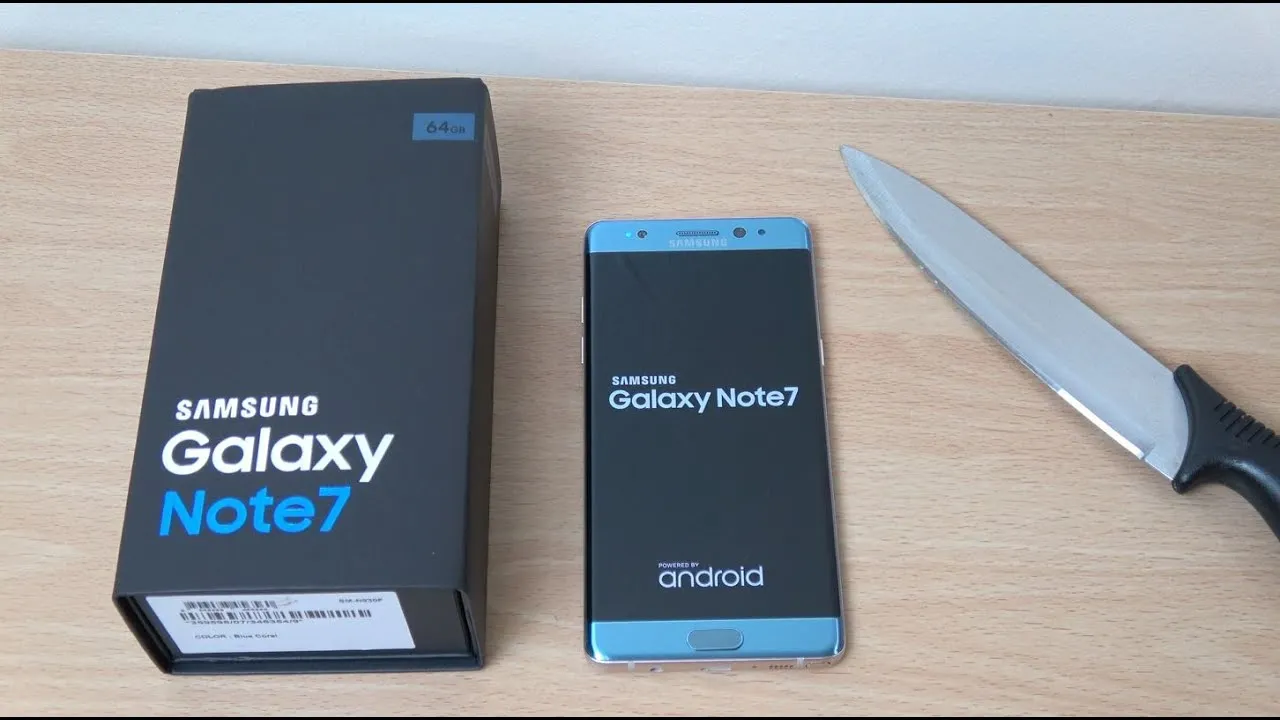
Introduction of Samsung Galaxy Note 7
The Samsung Galaxy Note 7 is one of the most discussed smartphones in tech history not because of its success, but because of the global safety reversal that followed its launch. Released in August 2016, the Note 7 was initially praised for its premium design, curved AMOLED display, powerful performance, and refined S Pen experience. It was positioned as Samsung’s most advanced smartphone at the time and quickly gathered attention from reviewers and consumers alike.
Overview what the Note 7 was
The Samsung Galaxy Note 7 was a 2016 flagship phablet by Samsung Electronics. Key selling points at launch:
- Display: 5.7-inch Quad HD Super AMOLED, dual spiral edges (edge screen).
- Processor: Region-dependentExynos or Qualcomm Snapdragon.
- Memory & Storage: 4 GB RAM, 64 GB storage with microSD support.
- Camera: 12 MP rear with Dual Pixel autofocus; 5 MP front.
- Battery: 3500 mAh non-removable (the component later linked to failures).
- Extras: S Pen stylus, IP68 water defiance, iris scanner, fast charge.
Reviewers liked the Note 7 for hardware polish and the S Pen workflow. The battery, however, became the safety liability that defined the model’s lifecycle.
Launch, demand, and early problems
- August 2, 2016: Samsung announces Galaxy Note 7.
- Mid–late August 2016: Retail sales begin in many markets.
- Early September 2016: Reports surface of overheating and fires while charging.
- September 2016: Samsung pauses sales in multiple markets and institute an investigation and recall program.
- September 15, 2016: U.S. Consumer Product Safety Commission (CPSC) issues a recall notice and joins the effort.
- October 2016: Samsung halts Note 7 production, issues a global recall, and suspends replacements after failure reports.
- Late 2016–2017: Samsung offers a limited Galaxy Note Fan Edition (Note FE) in certain markets, a recondition unit with a reduced-capacity battery and tighter safety checks.
Short take: Widely praised at launch → battery incidents → recall and replacement plan → replacement failures → global stop and permanent discontinuation.
The recall actions by Samsung and regulators
When multiple units failed and safety incidents escalated, Samsung and regulators followed these broad steps:
- Suspended sales and began internal investigations into reported incidents.
- Issued voluntary recall programs in many countries; later, formal recalls were posted by regulators (for example, the CPSC in the U.S.).
- Provided Refunds or replacements for affected customers.
- Produced replacement units and shipped them; after replacement unit incidents were reported, Samsung forever stopped production and ordered another global recall.
- Issued over-the-air updates to limit charging of recalled phones, and published official return and recycling guidance.
- Airlines and transport regulators restricted or banned Note 7 devices on flights during the recall.
Owner guidance during recall: Power off the device, stop charging, and return the phone for refund or safe disposal following official instructions.
Technical root cause simple, accurate explanation
Lithium-ion battery basics (very short): cells contain an anode (negative), cathode (positive), separator (thin insulating film), electrolyte (ion conductor). If the separation fails or internal components deform and contact, a short circuit can occur. That short can cause thermal runaway, a rapid, self-reinforcing heating process that can result in fire or explosion. Investigators concluded the Note 7 failures were caused by two distinct manufacturing defects originating from two different cell suppliers. Both defects could lead to internal shorting:
- Cell deformation / misalignment (Supplier A)
- Electrode layers or the jelly-roll were compressed or deformed during assembly.
- That deformation reduced the internal position so the anode and cathode could contact through the separator, causing internal shorting.
- Manufacturing/welding/insulation defects (Supplier B)
- Defective welds and inadequate insulating structures allowed sharp points or burrs to breach the separator.
- Welding spatter or foreign material creates constraint short paths.
Bottom line: two separate faults, poor internal spacing and weld/insulation flaws both ultimately allowed internal shorts and thermal runaway. The problems were manufacturing-level defects rather than a single accidental design choice.

What Samsung changed after the crisis
Samsung introduced an eight-point battery safety validation protocol to avoid future repeat events. Major components of that program include:
- Visual inspection of cells for defacement and foreign material.
- X-ray and CT (tomography) inspection to see internal defects without disassembly.
- Charge/discharge stress testing at high currents to detect abnormal heating.
- External short, overcharge, and forced discharge tests to observe failure modes.
- High temperature, drop, and mechanical stress tests to simulate rough handling.
- New supplier controls and tighter QA at cell constructor.
- Unit-level aging and cycle tests before product shipment.
- Expanded batch and cell traceability to tie serials/IMEIs to battery batches.
These additions improved product safety and supplier oversight in later Samsung flagship batteries.
Is a Note 7 still dangerous today?
Yes. Unless a Note 7 has been officially processed through a recognized refurb program (for example, the Galaxy Note Fan Edition manufactured by Samsung in limited numbers), original Note 7 units are considered unsafe.
- Original 3500 mAh Note 7 units are treated as potentially dangerous. Do not charge or use them.
- Galaxy Note Fan Edition (Note FE) a special, limited refurbished product made from returned Note 7 hardware but with battery replacements (smaller ~3200 mAh) and extra tests. Note FE units are different from original remember Note 7 units and were sold only in certain markets. Confirm a unit’s status before assuming it’s safe.
If you find or own a Note 7, verify its IMEI/serial with Samsung or your carrier and follow official recall instructions.
How to identify a recalled or unsafe Note 7
If you encounter a Samsung Galaxy Note 7, follow this checklist immediately:
- Power off the device. If on, turn it off safely.
- Do not charge it. Avoid plugging it into power or leaving it on a charger.
- Check the IMEI or serial number. Use Samsung’s official recall lookup or contact your carrier to confirm recall status.
- Look for software warnings. Official updates sometimes displayed messages instructing users to power off and return phones.
- Observe physical signs: swelling, protrude back cover, unusual warmth, burning odor, charring, or smoke.
- Confirm if it’s Note FE: packaging, model number, seller documentation, or Samsung support can confirm whether the unit is a Note FE refurbished model.
- If uncertain, treat it as unsafe. Do not use or charge; follow safe disposal steps below.
Why IMEI check matters: IMEI ties the handset to production records and any official recall lists; it’s the definitive way to confirm whether a particular unit was part of recall batches.
Safe disposal and return steps
If you have an unsafe Note 7 or find one:
- Power it off. Do this immediately.
- Place it somewhere safe. Put the phone in a cool, non-flammable repository away from flammable materials (e.g., concrete floor, ceramic plate).
- Contact Samsung or point of purchase. Follow the vendor’s and Samsung’s return/refund instructions.
- Check local recycling programs and regulator guidance. Many municipal and national programs accept recalled electronics.
- If shipping is required, use official instructions. Carriers and Samsung provided special procedures and packaging; follow them to prevent in-transit incidents.
- If the battery is swollen, smoking, or on fire, call emergency services. Treat it like any hazardous-material incident.
- Do not attempt to open the phone or remove the battery yourself. Built-in lithium-ion packs can be extremely dangerous to penetrate or disassemble.
Quick specs table
| Feature | Note 7 (typical) |
| Display | 5.7-inch Quad HD Super AMOLED (curved) |
| RAM | 4 GB |
| Storage | 64 GB + microSD |
| Rear camera | 12 MP (Dual Pixel) |
| Front camera | 5 MP |
| Battery | 3500 mAh (original, recalled) |
| Notable | S Pen, iris scanner, IP68 |
Samsung Galaxy Note 7 Pros and Cons
Pros
- Excellent AMOLED display
The 5.7-inch Quad HD Super AMOLED screen distributes deep blacks, vivid colors, and excellent outdoor visibility. It was one of the best smartphone displays of its time. - Premium design and build quality
Glass and metal construction with curved edges gave the Note 7 a modern, high-end feel that influenced later Samsung flagships. - Outstanding S Pen experience
The S Pen offered pressure sensitivity, precise input, and productivity features like screen-off notes, making it ideal for power users and professionals. - Strong performance at launch
Powered by Exynos or Snapdragon processors, the Note 7 handled multitasking, gaming, and productivity apps smoothly in 2016. - Water and dust resistance (IP68)
One of the first Note devices with full water resistance, adding durability and peace of mind. - Reliable camera system
The 12 MP Dual Pixel rear camera generates sharp photos, fast autofocus, and good low-light performance. - Advanced Security Features
Iris scanning, fingerprint recognition, and Samsung Knox provided multiple coatings of device security.
Cons
- Serious battery safety issues
Battery defects caused overheating, fires, and explosions, making the device unsafe to use. - Global recall and discontinuation
The phone was indelibly recalled and production was stopped, ending all official support. - Replacement units also failed
Even replacement devices showed battery problems, eliminating confidence in safe usage. - Flight bans and public safety warnings
Airlines and regulators banned the device from flights, severely damaging its reputation. - No long-term usability today
Original Note 7 units cannot be safely charged or used under any circumstances. - Software updates discontinued
Since the recall, Samsung stopped all software and security updates for the model. - Resale and ownership restrictions
Selling or using an original Note 7 is restricted or illegal in many regions due to safety laws.
FAQs
The Samsung Galaxy Note 7 was officially announced on August 2, 2016, and retail sales began in mid to late August 2016 in several countries.
The Galaxy Note 7 was recalled due to serious battery defects that caused some devices to overheat, smoke, or catch fire. These issues posed a fire and safety risk to users.
Battery manufacturing defects led to internal short circuits inside the lithium-ion cells. These short circuits triggered thermal runaway, a rapid rise in temperature that can result in fire or explosion.
No single design flaw caused the issue. Investigations showed two separate manufacturing defects from two different battery suppliers, both leading to dangerous internal short circuits.
Yes. Some replacement Galaxy Note 7 devices also overheated and failed, which led Samsung to permanently stop production and issue a global recall.
Yes. Original Galaxy Note 7 units are still considered unsafe and should not be charged or used under any circumstances.
Conclusion
The Samsung Galaxy Note 7 stands as a powerful prompting that even the most advanced technology can fail if Safety Margins are pushed too far. While the device was talented and well-received at launch, battery manufacturing defects ultimately led to one of the largest recalls in consumer technology history. Samsung’s decision to halt production and recall every unit worldwide was costly, but necessary to protect users and restore trust.
