
Intro Of Samsung Galaxy Note 10+
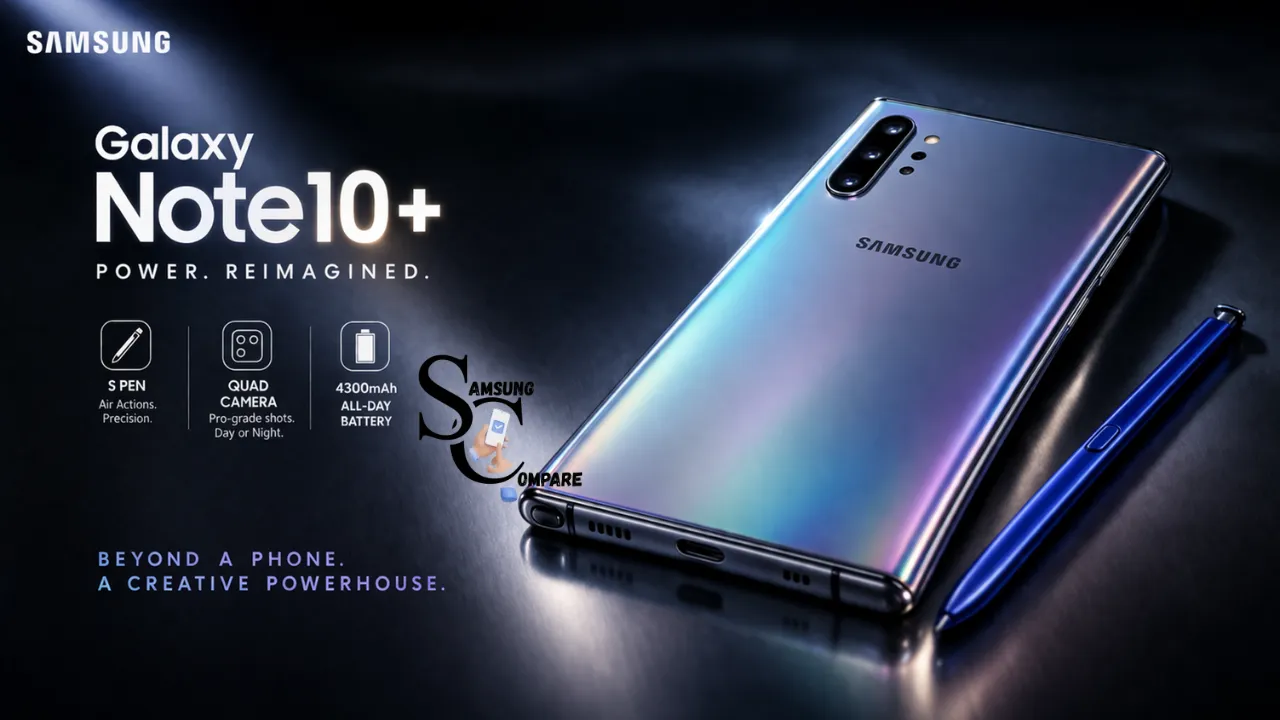
The Samsung Galaxy Note 10+ is still one of the most Distinctive large-screen phones Samsung has ever made. Even in 2026, it stands out for a reason: a huge Dynamic AMOLED display, a Bluetooth S Pen, 12GB of RAM, expandable storage, and a premium glass-and-metal build that still feels flagship-grade. For buyers who value productivity, note-taking, split-screen multitasking, and stylus control, it remains a surprisingly capable used or refurbished option.
That said, the Note 10+ is no longer a “buy it for the latest everything” phone. Its value in 2026 comes from a different place: it is a purpose-built productivity device with a big, beautiful screen and a unique S Pen workflow. If you are shopping used, the real question is not whether it is old. The real question is whether its features still match how you actually use a phone.
Why the Samsung Galaxy Note 10+ Still Wins Hearts in 2026
Even years after its launch, the Samsung Galaxy Note 10+ continues to attract users who want more than just a basic smartphone. What makes it special is the combination of a massive, vibrant display and the powerful S Pen, which transforms everyday tasks into a more productive and creative experience. Whether you are taking quick notes, editing documents, or multitasking between apps, the device still delivers a smooth and reliable performance. For budget-conscious buyers in 2026, it offers flagship-level features at a much lower price, making it a smart choice for those who value functionality, style, and real-world usability over the latest trends.
Essential specs at a glance
Treat the device as a fixed-length feature vector describing the product. Important features:
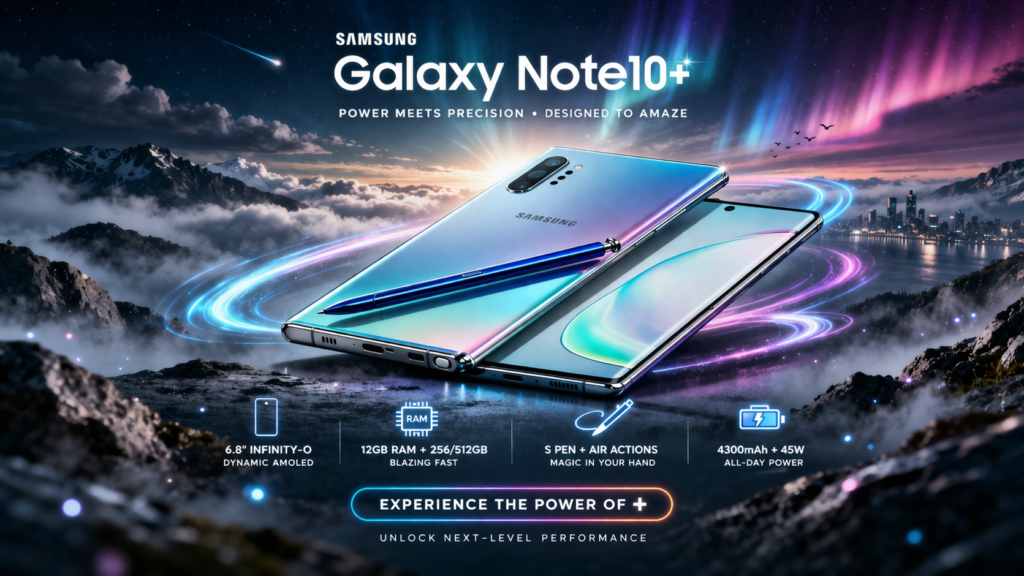
- Product: Samsung Galaxy Note 10+ (SM-N975 series)
- Release Date: August 2019 (retail release Aug 23, 2019)
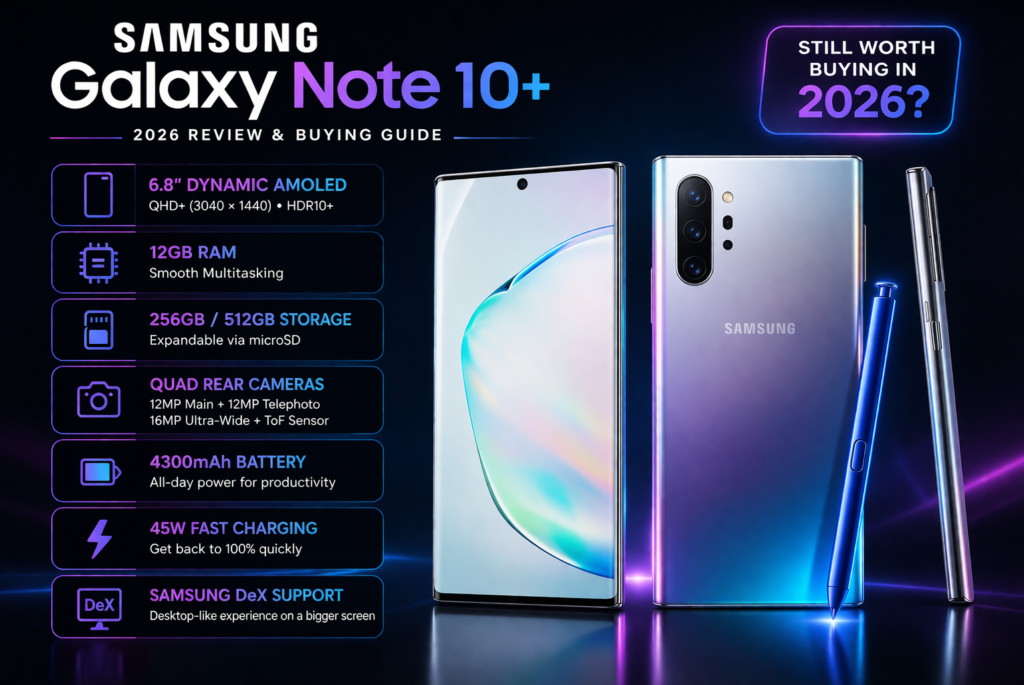
- Display: 6.8″ Dynamic AMOLED, QHD+ (3040×1440), HDR10+
- Chipset: Exynos 9825 (global) / Snapdragon 855 (US/China)
- RAM: 12GB
- Storage: 256GB / 512GB + microSD (expandable)
- Rear Cameras: 12MP main (OIS) + 12MP telephoto + 16MP ultra-wide + ToF
- Front Camera: 10MP
- Battery: 4300mAh
- Charging: 25W in-box; supports 45W charging
- Wireless: Qi wireless + Reverse broadcast charging
- S Pen: Bluetooth-enabled with Air Actions (remote controls)
- Build: Glass front/back, aluminum frame, curved edges
- Water resistance: IP68
- Repairability: Low (curved AMOLED + glass sandwich)
- 5G: Note10+ 5G variant exists (market-dependent)
Top takeaway
The Note 10+’s vector accentuates productivity-oriented features (large display, S Pen, generous RAM, expandable storage). In 2026, those dimensions remain meaningful for users mapping to productivity or stylus-centric tasks, while update and imaging feature dimensions have aged comparatively to 2022–2026 flagships.
Design & display
What still works
From an NLP metaphor: imagine a model that produces highly legible text. The Note 10+’s display is that legible rendering. The 6.8″ Dynamic AMOLED produces high contrast, deep blacks, and a color gamut suitable for reading, editing, and media. The curved glass and thin bezels give a modern surface form; the central punch-hole selfie camera decreases intrusion into the visual token stream.
- Tactile UX: Curved glass + Aluminum Frame = premium hand-feel (higher perceived quality score).
- Content rendering: QHD+ resolution and HDR10+ support. Amplify perceived sharpness and dynamic range for text, images, and video.
- Layout space: 6.8″ canvas benefits split-screen multitasking and practical desktop modes (DeX).
What’s dated
- 60Hz native refresh: Modern phones (2021–2026) often use 90–144Hz displays. That means motion vectors (UI transitions, scrolling) are less smooth, a perceptual penalty for users sensitive to low-latency rendering.
- Curved edge trade-offs: While aesthetically pleasing, curved screens raise repair costs and complicate third-party glass replacements due to the compound inflection and adhesive patterns.
Practical recommendation (loss function optimization): if your objective function includes plainness (gaming, rapid scrolling), prefer a 120Hz+ device. If your objective weighs pen precision and screen real estate heavily, Note 10+ remains competitive.

Performance
Describe the CPU/GPU/RAM combo as mathematics back-end resources for on-device models.
Raw compute profile
- Exynos 9825 / Snapdragon 855: 2019 flagship SoCs that offered strong numerical and floating-point performance for their era. By 2026, their raw computer lags modern silicon (2022–2026 flagships), especially in GPU-bound workloads.
- 12GB RAM: still indulgent for multitasking and large app working sets. In an analogy, this is like having wide transformer layers; the device can keep many application situations active simultaneously.
Real-world performance
- Everyday apps: Snappy for email, web browsing, office suites, document editing, and social media.
- Multitasking: Excellent due to 12GB RAM, fewer context refreshes, and better background process retention.
- Gaming: Moderate. Many modern titles will run at playable frame rates if settings are lowered. If your benefit function is competitive gaming (high FPS, minimal latency), this device will not produce the best score.
DeX and productivity
Samsung DeX turns the Note 10+ into a desktop-like environment. With an acceptable adapter or wireless DeX link, the device’s compute-plus-RAM combo is sufficient for document workflows, light photo editing, concluding sessions, and remote-desktop usage.
Optimization tip: For heavy compute tasks (machine-vision inference, prolonged gaming), consider a modern flagship or cloud-assisted workflows.
Camera
Treat the camera module as an encryptor that transforms photons into image tensors. The Note 10+ has a competent physical sensor stack but lacks many modern computational enhancements.
Strengths
- Daylight photography: Accurate color reproduction and usable effective range; the baseline ISP (image signal processor) produces Solid JPEGs out of the box.
- Video stabilization: Competitive for miniature capture and vlogging in 2026 for casual use.
- Optical telephoto: Offers true 2x optical zoom, useful for portrait framing and distant essence capture.
Weaknesses
- Night photography: The arithmetic photography models available on newer phones (2022–2026), multi-frame stacking, large-pixel vernacular sensors, and advanced denoising ML stacks outclass the Note 10+.
- Advanced AI features: Modern features such as more sophisticated HDR stacks, on-device super-resolution, or aggressive scene blending are less capable here.
Practical advice: If your distribution of usage comprises heavy low-light photography, the Note 10+ will suffer elevated reconstruction error. For daylight and video stability, it’s still serviceable.
S Pen deep dive
The S Pen is the device’s most distinctive and enduring feature. Think of it as a domain-specific input token that dramatically increases downstream productivity performance for definite tasks.
Why the S Pen still matters in 2026:
- Precision input: Low-latency pen solidus produces high-fidelity handwritten input; magnificent for annotation, diagramming, and precise edits.
- Air Actions & Bluetooth: Remote control capability (gesture-triggered shutter, media control, app shortcuts) extends the device’s relation affordances beyond touch.
- Productivity integration: Native Samsung Notes features handwriting-to-text conversion, screen-off memos, PDF annotation, and export to Word/PDF construct a useful pipeline.
Battery & charging
Treat battery capacity as a time-limited resource whose health decomposes over time (battery aging model). In the used market, battery health is a primary fluctuation affecting total utility.
Original spec vs. used reality
- Nominal capacity: 4300mAh.
- In-box charging: 25W; device supports up to 45W (charger not bundled).
- Used-unit expectations (2026): Degradation is inconstant; many units may offer decreased cycle capacity (e.g., 70–90% of original). This translates to 4–7 hours screen-on time under adequate usage if health is above ~85%; lower if degraded.
Diagnostics & buying strategy
- Ask for battery health: If the seller can dispense data (e.g., via device settings or diagnostic apps), prefer units >85% health.
- Quick test: Watch battery fall from ~80% to ~20% during a real-world utilization session, or ask the seller to run a video loop test to gauge drain.
- Replacement: Battery replacements are undemanding, but the cost varies by region. Replacing the battery restores runtime but not the sealed warranty.
Charging tip: If you sequence fast top-ups, buy a 45W charger separately; otherwise, 25W works fine for daily use.
Software & updates
Frame software supports the lifecycle management of a deployed model. The Note 10+ received a fixed casement of major OS and security updates.
Support history
Samsung provided multiple Android versions during the device’s early life, but mainstream major update support and regular security patches ended after several years. Many variants reached end-of-life for major Android updates in the 2022–2023 window, and security patch measures slowed or stopped regionally thereafter.
What this means for buyers
No major OS updates: The device won’t receive the latest Android versions, limiting access to certain new APIs, platform features, or security strengthening improvements.
Security patches: Depending on the region/carrier, security patching may have stopped or become infrequent. This raises a developing security risk over time.
App compatibility: Most mainstream apps continue to function, but future apps may require newer platform APIs. Over time, despising libraries or frameworks may lead to app incompatibilities.
Custom ROMs: Enthusiasts can run community ROMs (LineageOS and similar) to extend life, but this requires advanced knowledge and may void trust gesture (warranty, stability).
Repairability & parts
In maintainability terms, the Note 10+ carries some technical debt due to its curved AMOLED and glass sandwich construction.
Teardown reality
- Low repairability score: Curved panels enlarge replacement complexity and cost. Many screen repairs require front-assembly swaps.
- Common inexpensive parts: S Pen replacements, some cosmetic elements, and certain internal connectors may be cheaper.
- Costly repairs: Full display replacement and back glass replacement are expensive.
Practical tips for buyers
- Prefer units with an intact screen; cracked screens dramatically reduce resale value and increase repair cost.
- Budget for potential screen repair when designing total cost-of-ownership (TCO).
- Battery replacements tend to be tolerable in cost and worthwhile if the rest of the device is in good shape.
Pros & Cons
Pros
- A large, beautiful display is exceptional for media and multi-window productivity.
- Rich S Pen features handwriting, annotations, and remote controls.
- 12GB RAM maintains strong multitasking capability in 2026.
- Expandable storage (microSD) is flexible for large media libraries.
- Premium construct & IP68 water resistance.
Cons
- 60Hz refresh estimate is not as smooth as contemporary 120Hz+ devices.
- Aging camera system vs modern flagships’ low-light and computational photography limitations.
- End-of-life for OS & security updates in many revisions.
- Expensive screen repair due to curved AMOLED and glass construction.
- No headphone jack.
FAQs
Yes, particularly for users who value the S Pen and large-screen productivity on a budget. It’s not recommended if you need the newest cameras, the smoothest displays, or guaranteed long-term Android updates.
Some market-specific Note 10+ 5G variants exist. Confirm the specific model (carrier/region) before purchase.
Depends on the individual unit’s health. In the used market, battery capacity varies; prefer units with battery health >85% or factor replacement cost into the purchase.
Yes, the Note 10+ supports expandable storage via microSD.
Yes, it is IP68-rated for water and dust resistance when seals are intact
Final Verdict
The Samsung Galaxy Note 10+ is still a strong productivity phone in 2026 if your priorities are the S Pen, a big AMOLED display, strong multitasking, and good value in the used market. It is not the best choice for buyers who want the latest software, the smoothest Display, or top-tier low-light photography, but it remains one of the most practical older flagship phones for focused everyday work.
For the right buyer, it is still an excellent buy. Just check the battery, screen condition, and software status before you commit.
