
Introduction
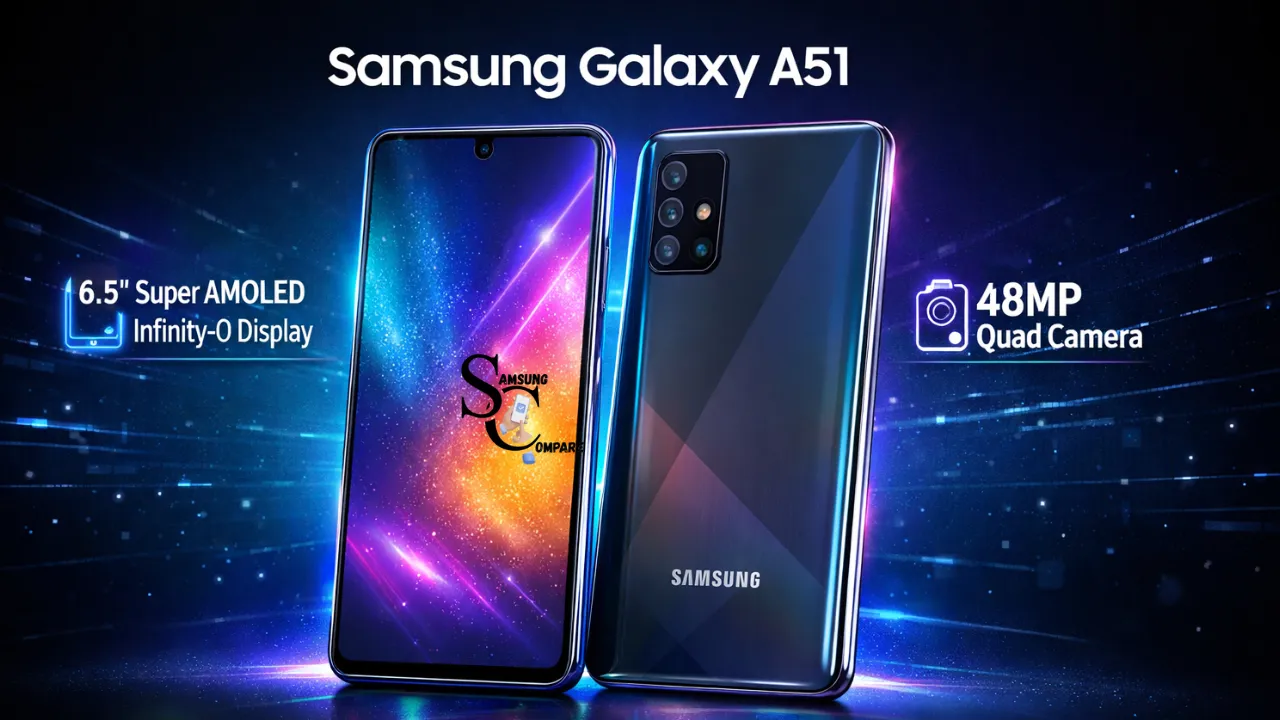
Even now, six years later, the Galaxy A51 keeps showing up online – its shape hasn’t gone out of style. That thin frame still feels modern in hand. The screen? A Super AMOLED panel held up surprisingly well compared to others in its class back then. When Samsung introduced it in 2020, the phone came with a 6.5-inch Full HD+ display using the Infinity-O cutout. Instead of cluttering the front, they placed the camera punch-hole in the top center. Photos were handled by a 48-megapixel primary lens. Up front, the selfie used a 32-megapixel sensor. Power came from a 4,000mAh cell inside. Storage wasn’t fixed; buyers got different RAM and internal mixes depending on where they lived. Some versions even allowed extra space through a microSD card. Contactless payments worked too, but only if the model included NFC hardware. Charging topped out at 15 watts, nothing fast, yet functional.
Truthfully, in 2026, the Galaxy A51 doesn’t stand out as a smart pick for long-term use. Still, it might work well – say, as an extra handset or something basic for occasional tasks. People who care more about screen clarity than processing power could find it acceptable. This outlook comes down to how old its parts are now. Back then, update promises were limited; today’s policies go further. Take Samsung’s shift in 2022 – offering up to four major interface upgrades on recent phones. On top of that, security patches may last five full years now. Progress like that makes older models feel outdated fast. So while the A51 once made sense, newer alternatives simply offer better follow-through.
Sure, the A51 can still slip easily into a pocket. Its display holds up well under sunlight. Basic functions continue working without hiccups. Yet updates stopped arriving long ago. By 2026, outdated software will become harder to ignore. Handling sensitive tasks on it now carries extra risk. Newer models receive patches longer. Time alone pushes the A51 toward obsolescence. Built-in protections fade once support ends. Choosing one today means accepting limits. That reality stems from release year, not opinion.
Overview
What made the Galaxy A51 stand out wasn’t one flashy trait but how everything came together. A 6.5-inch FHD+ Super AMOLED screen fills the front, sharp and bright in most lighting conditions. Four cameras sit on the back, each handling different shots without needing extra gear. Up front, self-portraits get a boost from a 32-megapixel sensor. Power lasts through long days thanks to a 4,000mAh cell tucked inside. It feels light at just 172 grams, despite the full-size frame. Dimensions measure 158.5 by 73.6 by 7.9 millimeters – tight corners, smooth edges. Unlocking happens fast using either your face or finger on the display. Memory choices shift slightly based on where you are: 4GB, 6GB, or 8GB of RAM fit into those slots. Storage pairs with RAM levels, though exact mixes depend on local models. No single part screams for attention – but lined up, they make sense.
What made sense back then came down to balance. Not chasing top speed, the A51 focused on fitting well into daily life. A solid display sat alongside workable photo tools, a compact frame, lasting power, and small touches that added comfort over time. Look at Samsung’s Indian website, and you see highlights like smooth video capture, high-res filming, drawing over live camera, extra storage space of nearly half a terabyte, plus quicker plug-in refills. All of it pointed toward one idea – packed with tools, not just horsepower.
By 2026, the old math holds for owning it outright – yet what you’re paying for isn’t quite the same. Faster processors hide inside newer models now, along with updates that last years longer and night shots that stay sharp – all without costing extra when bought secondhand. The A51 keeps its charm, true – but time drags behind it like a frayed cable: worn cells, stale code, sluggish taps. Graceful? Yes, if looks were all, less so when speed and stamina decide your day.
Full Specs of the Samsung Galaxy A51
Samsung lays out the key specs straight on its site. Not just size, but clarity stands out: this phone has a 6.5-inch Full HD+ Super AMOLED screen with a cutout for the front camera. Underneath, power comes from an Exynos eight-core processor. Depending on where you are, memory choices include 4GB, 6GB, or even 8GB of RAM. Storage options range between 64GB and 128GB, yet there’s room to grow – microSD cards can add up to 512GB more. Four lenses watch the world from the back: a 48-megapixel main shooter leads, followed by a 12MP ultra-wide lens, plus two 5MP sensors handling close-ups and depth effects. Up front, selfies get serious with a 32MP camera. Inside, a 4,000mAh battery feeds power through at 15 watts when plugged in. Security skips keys – the display reads fingerprints, faces unlock too. Connectivity stays wide open: USB-C sits beside Bluetooth 5.0, some versions pack NFC, and Wi-Fi ac keeps pace online. Old-school? Maybe – but that 3.5mm port still carries audio to headphones. Some models let users run two SIMs side by side.
What those numbers show isn’t just why people liked it back then but also where it falls short now. Strong screen, decent cameras – typical high points for phones like this when new, still look okay if you only check the brochure years later. Yet the processor feels outdated, dragging everything else down as time moves forward. Worse yet, updates might stop sooner than expected, which matters most when picking up something already owned. Samsung says plainly: not all models get every upgrade, so newer versions of Android and One UI won’t reach every old device equally.
Design and Display
A fresh look keeps the Samsung Galaxy A51 in view, even next to budget models today. Light at 172 grams, thin at just 7.9 millimeters – holding it feels natural after minutes or hours. Specs straight from Samsung back this up, pointing to design choices favoring grip over bulk. Instead of feeling like machinery, it slips easily into daily use. Come 2026, how a phone sits in your palm still wins points before test scores ever do.
What keeps the A51 feeling fresh? The screen. At 6.5 inches, it uses Super AMOLED tech – Full HD+, punch-hole design – the kind Samsung highlighted at launch. That same display holds up now, years later. Instead of fading into mediocrity, it stands apart. Because AMOLED delivers rich contrast, true black levels, smooth video, crisp text, and comfort during nighttime scrolling. While budget handsets rely on duller LCDs, this one avoids flat colors and weak viewing angles. By 2026 standards, many parts age poorly; yet here, the panel stays sharp, vivid, involved. Other elements lag – but not what you see first. It’s still the thing your eyes trust.
What holds the A51 together today is how it shows things on screen. Habits like watching videos, scrolling feeds, texting, tapping links, catching up on headlines, or playing light streams? It handles those just fine visually. Samsung once called the display an “immersive” edge-to-edge Infinity-O setup when launching it – funny enough, that label sticks even now. The device has aged, sure, yet the screen doesn’t feel outdated – it feels solid, present, useful.
Performance in 2026
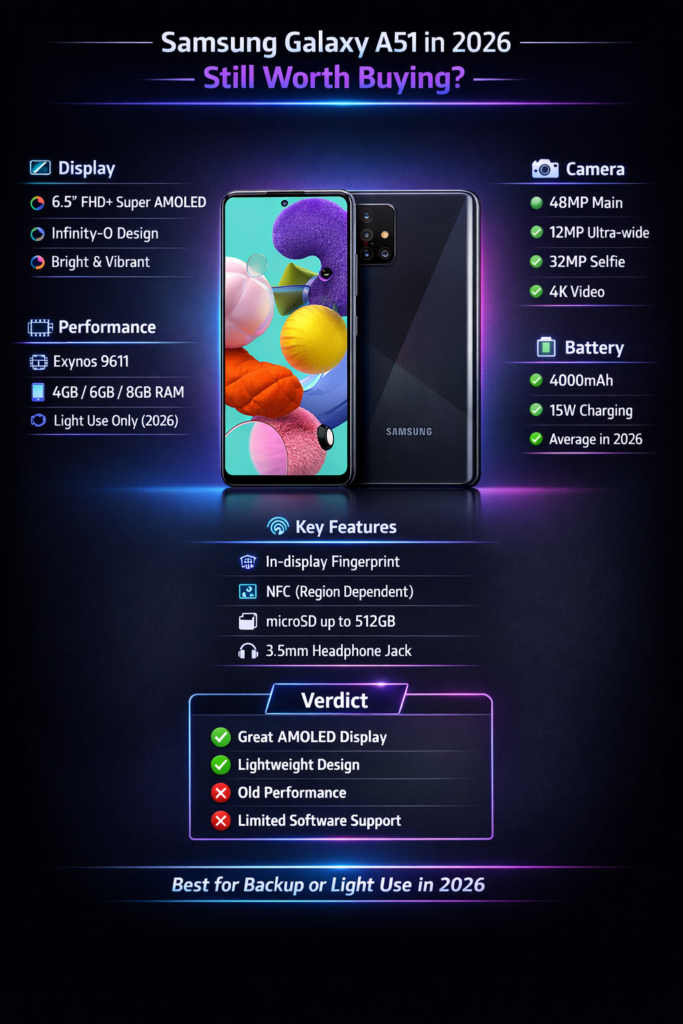
Performance stands as the key shortcoming of the Samsung Galaxy A51 by 2026. Though introduced with an Exynos octa-core processor, the chip simply cannot keep up with current apps, dense websites, or typical multitasking demands these days. Right from day one, this device targeted regular users wanting stability, not those chasing raw power. Instead of highlighting speed, Samsung’s original product messaging focused on real-world usability across its features.
Most days, the A51 manages calls, messages, web searches, directions, basic scrolling online, plus tools like calendars or alarms. Realistic thinking helps make daily use work fine. Yet speed lags behind fresh Galaxy A models, particularly during app launches, task jumps, or intense gameplay. This isn’t guesswork – it follows naturally from aging hardware meeting modern, bulky software demands.
A hands-on case shows what stands out. Checking messages, browsing news, answering chats, while switching to navigation? The A51 handles that much. Yet trimming clips, playing intense games, or running several tools behind the scenes – this exposes its limits fast. So by 2026, think of it as built for small tasks, never for heavy lifting. It runs, sure – but speed isn’t part of the experience anymore.
Camera Quality
One thing keeping the Galaxy A51 in sight? It’s a camera. A 48MP primary lens leads the pack, followed by a 12MP wide-angle unit sitting nearby. Close-ups get help from a 5MP macro shooter; depth sensing gets its own 5MP chip too. Even selfies aren’t ignored – there’s a 32MP front-facing sensor waiting. Over on Samsung’s Indian website, features like Super Steady Video pop up alongside UHD video capture. AR Doodle appears there as well, suggesting movement, play, more than just stills. It feels less like specs stacked high and more like tools meant to spark something.
Even when the light is just okay, pictures from the A51 tend to come out well. Family moments, quick social updates, relaxed portraits – these are what the primary sensor handles without issue. Framing wide views stays practical thanks to the secondary lens. Those who snap selfies regularly will find the 32-megapixel front camera holds up nicely. Specs on older models may seem outdated, yet this setup still brings solid value. Bright settings bring out its best, delivering images that meet basic needs easily.
Dim lighting shows how old a phone’s camera really is. Chunky grain, fuzzy edges, and shaky results often come from outdated parts inside. By 2026, the A51’s extra close-up and blur lenses seem like extras you glance past. They exist – sure – but folks pay attention to the Primary Shooter and wide-angle first. Daylight snaps hold up well enough on this model. Night shots? Not something you’d trust when things get dark.
Even when filming short videos, everyday moments, or uploads for friends online, this device holds up fine despite its limits. Where do recent phones pull ahead? Smoother motion handling, steadier shots in dim places, results you can count on every time. Samsung never claimed top-tier performance anyway; their messaging leaned into solid general use instead of records broken. By today’s standards, late 2025 expectations included that the approach fits. Lenses and sensors inside aren’t outdated overnight, yet they lack the sharpness, speed, and design touch others now treat as normal.
Battery Life and Charging
With a 4,000mAh battery and 15W charging, the Galaxy A51 meets basic needs as listed by Samsung. Back then, in 2020, this setup made sense. Now, in 2026, it holds up – just about – for those who ask only for essentials. It wasn’t sold as flashy, but steady, a phone built to last from morning to night. For its time, that promise fit right into its category.
What really counts now isn’t what the specs say about battery size; instead, it’s how well the power cell holds up after use. One A51 might carry heavy signs of age, while aging lithium inside slowly fades its ability to hold a charge. So even if both phones match on paper, their real performance could be worlds apart. When the battery stays strong, basic tasks throughout a quiet day go smoothly. But once that energy reserve weakens, everything slows down, drains faster, and feels less reliable. Buying secondhand? Pay close attention to the overall state, not just which device you’re holding.
Powering up works fine, though nothing stands out. The company says it supports 15 watts of rapid charging – a speed that seems sluggish now, even compared to recent models recharging much faster. Overnight topping off? That plan usually covers your needs. But grabbing quick boosts during busy hours makes the pace feel limited. This setup isn’t faulty – it’s just decent when fresh, average once aged, behind today’s curve.
Software Support and Security in 2026
Right here matters more than anywhere else if you plan to buy something this year. Updates shifted under Samsung’s watch – what they promised before isn’t quite the same now. Back in 2022, a pledge went out: certain Galaxy models could get as many as four major One UI jumps plus five full years of security patches. Still, performance limits and model-specific rules shape who actually qualifies, so even long-standing gadgets eventually hit a wall.
Timing plays a role here since the Galaxy A51 hit markets early in 2020, well ahead of when Samsung solidified its current update promises. Though never stated outright, treating this model like outdated tech fits the pattern set by release dates and later company updates. Built on earlier hardware standards, it falls behind recent models shaped by modern rules. While not guaranteed, expecting less longevity makes sense given how far past its debut we now are. Phones from 2020 simply do not line up with those released two or three years after them.
When it comes to real control over what you own, how old the software is matters more than just code. Trust shifts when versions grow stale. Comfort fades while logging in, saving private data, handling money tasks, and depending heavily on one gadget. What keeps things running often hides behind menus. Instructions appear on Samsung’s help sections for Galaxy phones – ways to scan for upgrades using Settings or move data with Smart Switch. Still, knowing where to look does not mean older models stay protected forever.
Here’s where things land. While the A51 works okay for basic tasks on a tight budget, it falls short if you want updates that last. When your phone handles work documents, banking tools, personal messages, or key logins, stepping up to a recent release makes more sense. This isn’t about scaring anyone – just matching reality: older hardware meets changed company priorities.
Connectivity and Everyday Features
Even now in 2026, Samsung hasn’t removed handy features from the Galaxy A51 – its lasting appeal owes much to that choice. Peek at the specs online and you’ll spot USB-C sitting beside Bluetooth 5.0, while some versions even include NFC. Wi-Fi ac keeps things swift, yet there’s still room for old-school needs: yes, the 3.5mm plug remains, along with space for a microSD card up to 512GB. Models made for certain regions offer two SIMs, too. For folks clinging to wired headphones or extra storage, these small choices make daily life less fussy.
Worth noting – the headphone port sticks around while plenty of recent models ditch it entirely. Plugging in regular earbuds works straight away on the A51, helpful for those walking to class, riding trains, or just avoiding extra charges for tiny wireless things. Touch payment ability shows up too, thanks to NFC, along with faster device linking when available nearby. Might seem minor at first glance, yet over time these bits ease routines more than expected, especially on secondhand devices.
Fingerprint scanning lives right under the screen on the A51. Face unlock comes included too, according to Samsung’s official specs. Neither meets the top-tier security seen on premium models now. Still, tapping power and seeing instant access work smoothly. When someone just checks messages or texts often, speed like this actually helps.
Pros of Samsung Galaxy A51 in 2026
Even today, the Galaxy A51 holds up in a few key ways that keep users interested. Brightness jumps out first – its 6.5-inch screen delivers rich colors and crisp clarity when watching videos. Holding it feels natural, thanks to a design that’s both narrow and light enough to slip into pockets without effort. Beyond looks, it packs practical extras like space expansion through microSD cards, an old-school audio port, contactless payments where available, along with cameras tuned for regular snapshots. Sharp visuals, comfort, real-world features – these pieces add up.
Comfort comes quietly. The A51 doesn’t surprise, but settles in like something you’ve used before. Samsung’s layout helps, so does the even mix of Parts Inside, along with looks that stay out of your way. Understanding how it works takes almost no effort. This ease makes a difference when tech fatigue sets in. Someone studying, raising kids, using an extra phone, or just checking messages might never need more. Its display stays clear, handling everyday tasks smoothly despite its older performance. Impressive speed? Not really. Yet getting through the day feels natural.
Plain talk about the main benefit? It boils down to this
Fresh as ever, the Super AMOLED screen holds up well.
A featherlight feel hits first – this one weighs just 172 grams. Thin lines run along its frame, shaping a sleek profile.
Fitted for daily shots, the camera adjusts easily to different scenes.
Fits a tiny card to stretch space when needed.
A few models still keep NFC. Alongside them sits a headphone jack, handy when needed.
Cons of Samsung Galaxy A51 in 2026
What holds the A51 back matters a lot, shaping why it’s harder to suggest now without hesitation. Built around an outdated Exynos processor, its ability to juggle tasks or handle intense applications falls short next to modern devices. If previously owned, the battery could already show signs of fatigue, leading to inconsistent usage between charges. Charging at 15 watts feels slow today, lagging what many expect. Updates and long-term software care aren’t as solid either, given its place in Samsung’s aging lineup.
Older tech creeps in when the lighting dims. Main and ultrawide sensors still pull their weight, yet the added macro and depth tools add little real value by 2026 standards. These feel like holdovers from budget models past. A plastic body lacks the upscale touch of glass or modern metal detailing, even if it trims bulk. For a spare handset, the compromise makes sense. Carrying one daily? That choice begins to show its years.
Here is the short version of the downside:
Old processor for 2026 standards.
Support is no longer current for a 2020 launch device.
Battery health depends on the unit you buy.
Night photos are only average now.
Charging speed feels slow compared with newer models.
Who Should Buy the Galaxy A51 in 2026?
One reason some people might look at the Samsung Galaxy A51 in 2026 is its role as a basic tool for everyday needs. For anyone needing just calls, messages, video watching, web visits, occasional photos, or a spare handset, it holds up fine. What helps? The screen looks sharp even now, plus the interface feels familiar and smooth. Instead of power, think clarity – its AMOLED panel stands out clearly. Even without top performance, it keeps core functions alive: USB-C charging stays useful, certain models offer contactless payments through NFC, and memory can grow with a card. Basic does not mean broken here – it simply fits quieter digital lives.
For parents, kids, or anyone needing a basic backup, this phone fits just fine. When ease beats speed, smooth handling counts more than raw power. Its mix of screen size and features keeps it useful despite age. Excitement has faded. Still, it gets things done without fuss.
Here’s how to think about it: get the A51 only when the cost feels right for something you’d use short-term or keep as backup. When a secondhand model costs almost as much as fresh A-series Galaxies, stepping up makes sense – faster performance waits there, along with longer updates and fewer surprises. Real worth in 2026 shows up best through that lens.
Who Should Skip It?
If your goal is to keep a phone for years, think twice before choosing the Galaxy A51 – its limits show up fast under pressure. Need smooth performance when switching between apps? It stumbles where others glide. Gamers will notice lag creeping in during intense sessions. Relying on just one gadget for tasks like mobile banking or high-res photo editing? This model falls short without warning. Even streaming video at full tilt exposes its weak spots over time. Newer Galaxy phones now promise longer software updates, leaving the A51 behind like an outdated blueprint. Its design feels stuck in an older era of expectations.
A phone with a worn-out battery might let you down fast. When screens flicker or ports wobble, problems often follow. If past ownership feels like a mystery, caution makes sense. Age alone doesn’t kill phones – how they’ve been treated does. One A51 runs smoothly, another drags after poor care. Updates pile up only when owners keep pace. Neglect shows faster on older models than most expect.
Best Buying Checklist Before You Buy a Used Galaxy A51
Look at the battery first if you plan to get a used Samsung Galaxy A51 in 2026. Old batteries often hide problems that quietly ruin how the phone feels every day. Check the screen next – AMOLED types sometimes show ghost images, scuffs, or unresponsive spots. Because screens matter so much, take time here; move fingers slowly across the surface. Once done, try out the camera, then play sound through the speaker while recording your voice. The fingerprint reader should React Fast, yet many older units slow down without warning. Plug in a cable to see if charging begins right away, since ports wear out faster than expected. Wi-Fi connections need checking too, along with whether the SIM works properly on a network. Software updates from Samsung depend heavily on model age, which affects long-term usability. Physical shape plus update availability together define what owning this phone will really be like.
A simple inspection flow works best
Check battery drain during a short test.
Inspect the screen for burn-in and touch response.
Open the camera app and test every lens.
Insert a SIM card and test calls and data.
Plug in a charger and confirm stable charging.
Check the software version and reset history if possible.
If the phone passes those checks and the price is attractive, it can still be a reasonable purchase. If it fails on battery, screen, or connectivity, move on. With a device this old, a single major flaw can outweigh the entire spec sheet.
FAQs
Yes, but only for basic use. The Galaxy A51 can still handle calls, messaging, browsing, YouTube, light photography, and simple daily tasks, especially if the battery is still healthy and the unit is well-maintained. Its 6.5-inch Super AMOLED screen is still a real advantage. Even so, the phone is no longer a strong long-term choice because the hardware is old and the software cycle is much less future-ready than newer Galaxy devices.
Yes. The display is one of the best things about the phone. Samsung’s official specs list a 6.5-inch Full HD+ Super AMOLED Infinity-O panel, and that kind of screen still looks excellent for media, reading, and everyday use. In 2026, it remains one of the main reasons this device still feels pleasant despite its age.
Only for light gaming. The A51 was built as a balanced mid-range phone, not a performance device, and that became obvious in 2026. Casual games can still run fine, but heavier games and long gaming sessions are not ideal because the chipset is old and the phone is no longer competitive with newer devices in sustained performance.
It has four rear cameras: a 48MP main camera, a 12MP ultra-wide camera, a 5MP macro camera, and a 5MP depth camera. It also has a 32MP front camera. Samsung’s official launch materials list those exact camera specifications, along with features such as Super Steady Video, UHD recording, and AR Doodle on the India launch page.
Yes. Samsung’s official product pages list microSD support up to 512GB on supported variants. That makes the A51 more flexible than many modern budget phones, especially if you want extra room for photos, videos, and offline media without paying for a larger storage tier.
Final Verdict
Even now, the Samsung Galaxy A51 holds up – not due to hype, but thanks to its smooth 6.5-inch Super AMOLED screen. A slim frame makes it comfortable to hold, while the cameras adapt easily to different scenes. Storage expands freely, since microSD fits right in. Some models carry NFC, handy where contactless matters. And yes, there’s still a headphone port – no dongle needed. These aren’t tricks or illusions. They’re honest features that age well. Used buyers notice them, which explains why demand lingers. Samsung didn’t oversell it at release – it aimed for balance. That calm confidence shows even after years pass.
Now it’s the flaws that stand out more than anything else, for most people looking to buy. That Exynos chip inside? It belongs to an older generation. Charging speed feels slow when compared to what’s common today. Used models often show strange battery behavior after time passes. Photos taken in dim lighting lack the sharpness current phones deliver. Updates and long-term software backing don’t inspire trust like they should for a primary device. Newer Galaxy handsets get help from Samsung much longer, which throws these limits into sharper light. Think of the A51 less as a forward-thinking choice, more as something holding on by habit. Its place now is clear – past its prime.
Here’s the bottom line: grab the Galaxy A51 only when it’s cheap, flawless, and basic tasks are all you need. Most people? They’re better off with a recent Galaxy A model – speedier, more secure, simpler to handle by 2026.
