

Introduction Of Samsung Galaxy A5
The Samsung Galaxy A5 (2015) was more than just another mid-range phone—it marked a turning point where Samsung began bringing premium design to affordable devices. With its slim metal body, vibrant Super AMOLED display, and reliable everyday performance, the A5 quickly stood out in a market dominated by plastic builds.
Fast forward to 2026, and while the Galaxy A5 series is no longer in production, it still attracts attention from budget buyers and refurbished phone seekers. Its balance of design, usability, and durability—especially in later versions—makes it a surprisingly relevant option for light users who prioritize build quality over raw power.
Overview: What is the Samsung Galaxy A5?
The Samsung Galaxy A5 is Samsung’s mid-range line that, at launch, focused on delivering an instalment feel (metal and glass) with mid-tier performance and sensible day-to-day features. Released across multiple years, the A5 family developed from a metal-bodied, compact handset into a more polished device with better cameras, larger batteries, and, by 2017, robust water/dust protection (IP68). For content creators, product pages, or buyers, the A5 series is a classic example of “popular premium” design.
Which A5 model should you care about? (2015 / 2016 / 2017)
Quick decision guide:
- A5 (2015) the baseline model: compact 5.0″ HD, metal frame, good for minimal users who want a small phone with a premium feel.
- A5 (2016) piecemeal improvements: 5.2″ screen, better battery, octa-core option. Good price/performance for daily tasks.
- A5 (2017) is the best value for long-term durability: retains compact size, adds IP68 water/dust resistance, USB-C, and improved 16MP cameras (both front and rear). If you’re purchasing a used/refurbished unit today, A5 (2017) is the one to target.
Recommendation summary: For longevity and resale value, choose A5 (2017). If price is the overriding concern and you find an extremely cheap A5 (2016) in good condition, it can still serve as a capable daily device.
Full technical specs comparison table & notes
Below is a concise comparison that covers the most searched spec fields. Use this as the canonical specs table for your page.
| Field | A5 (2015) | A5 (2016) | A5 (2017) |
| Announced | Oct 2014 (launched early 2015) | Dec 2015 | Jan 2017 |
| Display | 5.0″ HD Super AMOLED | 5.2″ Super AMOLED, 1080×1920 (~423 ppi) | 5.2″ FHD Super AMOLED (1080p) |
| SoC / CPU | Quad-core (varies by region) | Octa-core ~1.6 GHz | Octa-core ~1.9 GHz (region-dependent) |
| RAM | 2 GB | 2 GB | 3 GB (varies by market) |
| Storage | 16 GB (+microSD) | 16/32 GB (+microSD) | 32 GB (+microSD up to 256 GB) |
| Rear camera | 13 MP | 13 MP | 16 MP (f/1.9) |
| Front camera | 5 MP | 5 MP | 16 MP (f/1.9) |
| Battery | ~2300–2600 mAh | 2900 mAh | 3000 mAh (non-removable) |
| Charging | microUSB | microUSB | USB-C |
| Water / Dust | No | No | IP68 |
| OS at launch | Android 4.4 KitKat | Android 5.x/6 (varies) | Android 6.0 Marshmallow |
| Weight / Size | ~145 g | 144.8 × 71 × 7.3 mm / 153 g | 146.1 × 71.4 × 7.9 mm / ~157 g |
Notes for publishers: include model codes (e.g., SM-A520F for A5 2017) next to each entry, and publish the “last checked” date near the table (important for pages that show market availability).
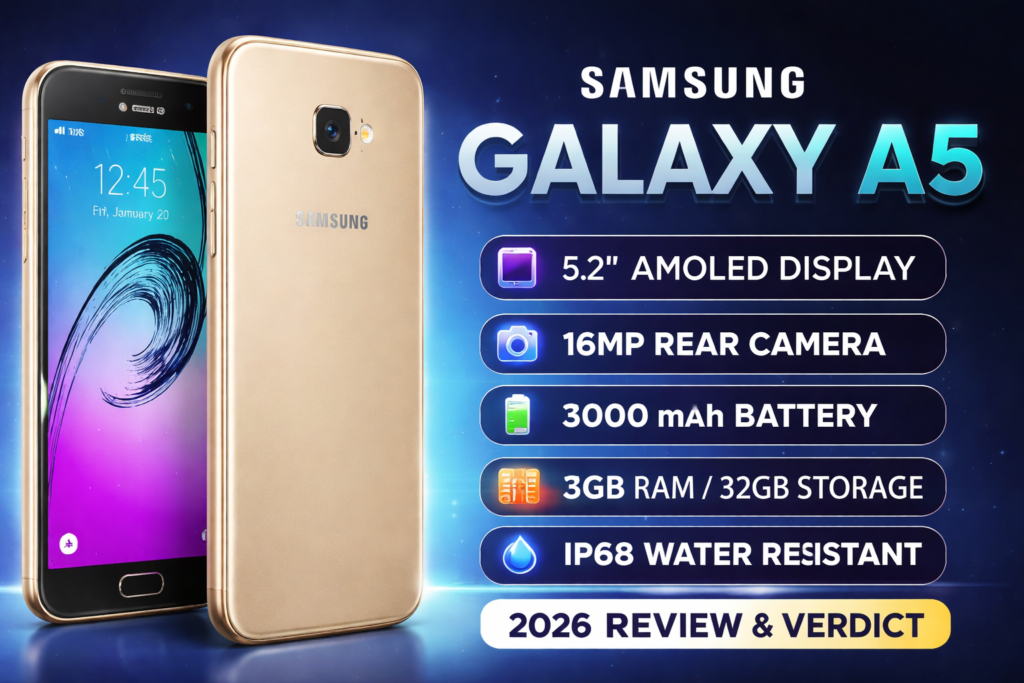
Design, display & build why A5 felt premium
A key reason the Samsung Galaxy A5 cut through the mid-range clutter was material choice. Where participants used plastic, Samsung pushed metal frames and glass backs (on later models), lending a tactile premium that reviewers often mentioned.
Design points to highlight:
- Materials & finishes: metal side rails and glass backs (2016/2017) with polished chamfers; color variants (Black Sky, Gold Sand, Blue Mist).
- Display: Super AMOLED panels produce deep blacks, rich colors, and good outdoor brightness for the class. The 5.2″ size is pocket-friendly and keeps one-handed usability high.
- Ergonomics: modest bezels and a chassis that balances weight distribution; the A5 remains comfortable after prolonged use.
- Durability: the addition of IP68 in 2017 is a major selling point that improves resale and real-world plasticity (note: seals can degrade; buyer checks matter).
Camera

The camera improvements peak in the A5 (2017), which upgraded both front and rear sensors to 16MP with a bright f/1.9 aperture. That combination helps in low light and improves sharpness.
Real-world summary:
- Daylight: All A5 variations take competent daylight photos; 2017 shows better dynamic range and detail.
- Low light: 2017’s f/1.9 aperture collects more light, producing cleaner shots and less noise than 2015/2016 models.
- Selfies: 2017’s 16MP front camera is notably better than the older 5MP modules, a selling point for selfie-centric buyers.
- Video: Acceptable 1080p clips; don’t expect flagship consolidation.
Sample gallery to include on page: daylight scene, low-light indoor, portrait/cropped, 100% crop demonstrating detail, and front-camera portrait. For trust signals, include EXIF for each sample (device, focal length, aperture, ISO, shutter speed).
Methodology to publish: same scene, tripod where possible, auto mode, default processing; list EXIF and shooting distance. This helps EEAT: users can transcribe results.
Battery & charging
Capacities: the A5 moved from ~2300–2600 mAh (2015) to 3000 mAh (2017). Coupled with an efficient AMOLED screen and mid-range SoC, expect one full day under ordinary use on the 2016/2017 models.
Practical expectations:
- Moderate use: 6–8 hours SOT (screen-on time) across a day with social apps, messaging, web ruminate, and some camera use (varies by condition and battery health for used units).
- Heavy use (gaming/streaming): 3–5 hours SOT.
- Standby: good due to efficient SoC and AMOLED.
Tests to include on your page:
- YouTube test: loop a standard video at 50% brightness and measure hours until 0%.
- Mixed day test: simulate model user day (email, social, short calls, photos).
- Charging: measure 0→100% time; A5 (2017) with USB-C usually charges faster than microUSB models, but neither supports very-high wattage fast charging.
For refurbished/used listings, add a battery-health checklist: ask the seller for typical SOT, measure battery temperature and charging behavior in-person, and recommend replacement if capacity is <80%.
Performance
Everyday tasks: social apps, web browsing, messaging, and video playback run smoothly on A5 devices. RAM constraints (2–3 GB) mean that heavy multitasking or many Chrome tabs will cause reloads, but typical users will be satisfied.
Gaming: casual and older titles run fine; modern AAA titles will require reduced graphics and show throttling.
Benchmarks
- Geekbench (single/multi) and AnTuTu snapshots (include firmware and region).
- App-switching test: measure how many apps/tabs before visible slowdowns.
- Thermal throttling note: increasing gaming leads to a warm chassis and dropped frame rates on older SoCs.
Publishing tip: show both synthetic benchmark screenshots and real-world recordings to satisfy both leaky readers and technical audiences.
Software & firmware
Samsung shipped different Android versions across A5 models. Official support ended years ago, which affects security updates and app compatibility.
Useful page elements:
- Update the history timeline list, original OS, and later official upgrades per model.
- Firmware/build numbers link to Samsung support pages for downloads.
- Custom ROMs, LineageOS, and XDA threads provide unofficial modern Android builds; add a flashing rejection and backup checklist.
Important caution: flashing custom ROMs void commitment and carries the risk of bricking. Provide clear step-by-step links and recommend experienced users only.
Why the Samsung Galaxy A5 Still Surprises in 2026
Even in 2026, the Samsung Galaxy A5 (2017) continues to surprise users who pick it up as a budget or secondary device. While it can’t compete with modern smartphones in raw performance, it still delivers where it matters most for everyday use—smooth social media browsing, reliable calling, and a premium in-hand feel that many newer budget phones lack. Its compact size, AMOLED display, and durable build make it especially appealing for users who prefer simplicity over overwhelming features. For anyone looking for a low-cost phone that still feels “premium,” the Galaxy A5 remains a smart and practical choice.
Buying guide
Because the A5 family is legacy hardware, most purchases will be used or refurbished. This section should be prominent on a product page.
Checklist for buyers
- Model code verification: e.g., SM-A520F (A5 2017) check Settings About phone and box.
- IMEI check: confirm the IMEI on the box matches the device; run a blacklist check for stolen/lost status in your country.
- Physical inspection: screen for burn-in, scratches, dead pixels; check back glass and frame for dents.
- Functional tests: cameras, microphone, speakers, Bluetooth, Wi-Fi, fingerprint sensor, and charging port.
- Battery health: ask for a typical SOT or run a quick drain test; recommend restoring the battery if capacity is much lower than original.
- Ports & accessories: verify charger type (USB-C vs microUSB) and ensure original or high-quality third-party accessories.
Pricing guidance: include up-to-date snapshots (date-stamped) from local marketplaces for local relevance (e.g., Daraz, OLX, eBay, Amazon). On your live site, update monthly and show the “last checked” date.
Seller protections: recommend a short return window, use escrow where available, and avoid sellers unwilling to allow inspection.
Repairability & spare parts guide
A robust repair section builds trust and reduces returns.
Common faults & fixes:
- Screen replacement: moderate difficulty due to glued assembly; often costs a remarkable portion of device market value.
- Battery replacement: straightforward for a repair shop; use OEM or high-quality aftermarket batteries.
- USB port wear: microUSB ports wear; 2017’s USB-C is more durable, but still a common fault if connectors are forced.
- Speakers & mics: dust and debris reduce volume; cleaning or replacements are low-cost fixes.
Pros & Cons
Pros
- Premium metal & glass design.
- Super AMOLED display with deep blacks.
- Comfortably compact 5.2″ size (2016/2017).
- Good selfie camera on A5 (2017) 16MP front.
- IP68 water/dust resistance in 2017.
- microSD slot for storage expansion.
- Practical battery life for the class.
Cons
- Not ideal for heavy gaming compared to modern flagships.
- Official updates ended years ago; security support was limited.
- Parts availability varies by region.
- Used collections may need replacement.
- Newer budget phones can beat performance-per-dollar now.
FAQs
A: A5 (2017) is the best overall value: it combines improved cameras (16MP), a larger battery (3000 mAh), USB-C, and IP68 water/dust resistance. If you want longevity and fewer deal-breaking hardware omissions, choose 2017.
A: Yes. Most Galaxy A5 models include a microSD slot for expandable storage; capacity limits vary by model and region, so check the exact model code for the supported maximum.
A: Yes. The A5 (2017) carries an IP68 rating, giving protection from dust and immersion in water up to a rated depth (typically 1.5m for 30 minutes in fresh water). Keep in mind, seals can wear to avoid prolonged exposure to saltwater, and verify seals on used devices.
A: Official major Android updates for these models ended long ago. However, community ROMs (e.g., LineageOS) sometimes bring newer Android versions. Flashing custom ROMs has risks; following reputable guides and backing up data.
A: Verify model code in Settings → About phone, check IMEI on the box and device, inspect build quality and screen, test cameras and sensors, and compare the device to official Samsung specs or images.
Conclusion
The Samsung Galaxy A5 series remains a standout example of how Samsung successfully introduced premium design into the mid-range category. Across its 2015, 2016, and 2017 iterations, the A5 steadily improved in performance, camera quality, and durability—culminating in the well-rounded A5 (2017).
In 2026, it’s no longer a Primary Device for most users, but it still makes sense as a budget-friendly or secondary phone—especially if you value compact size and premium build quality.
