
Executive overview
The Samsung Galaxy A40 arrived in 2019 and held a rare position in the phone-product space: a compact mid-range phone that prioritized size and display over battery bulk or flagship silicon. If you model phones as high-dimensional feature vectors, the A40’s feature cinder track had strong weights for “compact form”, “AMOLED display”, and “front-facing camera quality.” Over time (2019 → 2026), the centroid of “value midrange” shifted: newer devices increased battery capacity, improved SoCs, and prolonged update windows. That shift moved the A40 further from the modern value centroid; it became an outlier. You can still like it for a specific niche, but not a broadly advocated buy.
Full specifications
| Feature | Details |
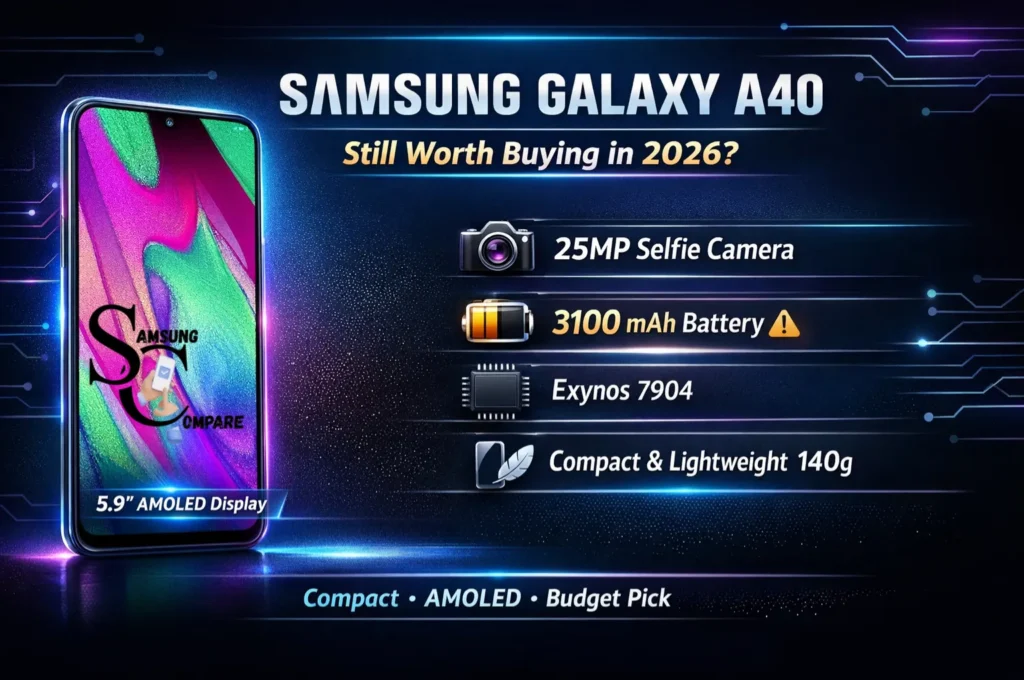
| Display | 5.9″ Super AMOLED, FHD+ (1080 × 2340) |
| Processor | Exynos 7904 |
| RAM | 4 GB |
| Storage | 64 GB + microSD |
| Rear camera | 16 MP (main) + 5 MP (ultrawide) |
| Front camera | 25 MP |
| Battery | 3100 mAh, 15W charging |
| OS | Android 9 → Android 11 |
| Weight | ~140 g |
| Build | Plastic back, glass front |
(Consider the above table as a canonical set of tokens for product features useful when writing metadata, templates, or feeding into an automatic spec extractor.)
Design & display
Compact done right, one-hot features, and human comfort
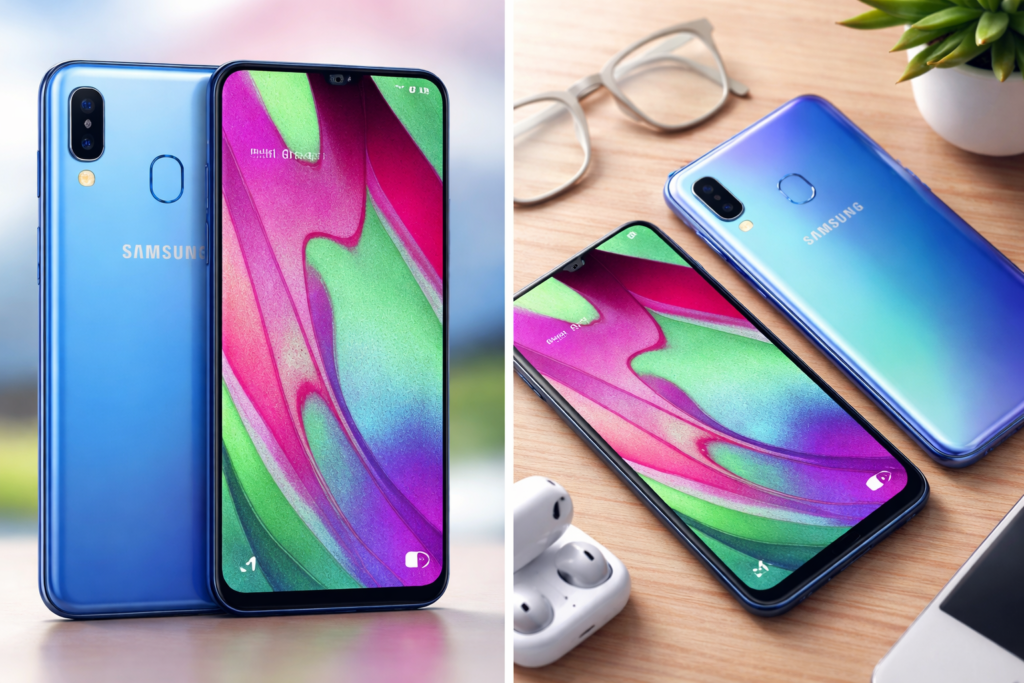
The A40’s single most telling attribute is its size. In a market that quickly drifted toward devices with 6″+ screens, Samsung deliberately set a lower proportions score for display diagonal and weight. The result: a phone that’s easy to handle in one hand, pocket-friendly, and comfortable for long single-hand operations. If you value ergonomics, the A40’s low “hand-fatigue” token scores highly.
Build & feel
- Plastic rear, glass front, this combination trades premium texture for lightness and impact resilience.
- Slim profile and small footprint make it friendly for users with smaller hands or those who dislike pocket-filling slabs.
Display quality
- The 5.9″ Super AMOLED remains the standout. In absolute visual terms: deep blacks, saturated colors, a high contrast ratio, and pixel density that keeps text crisp.
- For media expenditure and social content, the A40’s display still offers a superior perceptual experience compared to many older budget LCD devices. In NLP parlance, its perceptual embedding for “display quality” remains near the high end for its class.
Verdict on design & display
- Compact, comfortable, and still visually impressive.
- Materials and finish aren’t flagship-class.
Performance
Processor overview: Exynos 7904
The Exynos 7904 smartphone’s mainframe is like the brain that helps the smartphone think. The formerly hummingbird 7904 has a brain compared to the new smartphone processors developed between 2022 and 2026.
The Exynos 7904 was an average smartphone processor in 2019. The Exynos 7904 is old news in 2026.
Real-world behavior:
- Lightweight tasks (messaging, calls, web browsing, social media) are tokens that map well to the A40’s compute graph, Low Latency, smooth execution.
- Heavy tasks (modern gaming, complex multitasking, big app loads) produce large activation values that the chip struggles to compute efficiently, leading to lag, frame drops, and thermal throttling.
Gaming & heavy apps
- Modern mobile games stress both the GPU and the sustained CPU. The A40 can run many titles only on downgraded settings and may still show noticeable frame instability and occasional overheating.
Comparison with modern low-cost models
- Phones released 2021–2025 improved single-thread and multi-thread performance; low-cost chips began offering more cores, better GPUs, and more efficient process nodes. These give newer budget devices higher throughput and better battery-thermal balance.
Verdict on performance
- Acceptable for daily basics.
- Not future-proof. Avoid if you plan on heavy apps or gaming.
Camera System
Front camera (25 MP): the star token
The front camera of the A40s is its special feature.
It can take selfies with lots of details in good lighting.
The skin tones, edges, and brightness are good enough to share on media.
If you are taking lots of selfies for media or video calls, the front camera of the A40s is still good.
The front camera of the A40s is great, but only if you want to take selfies.
Rear cameras: practical but modest
- 16 MP main: performs well in daylight for casual snapping; decent color reproduction.
- 5 MP ultrawide: useful for framing alternatives, but low resolution limits cropping and low-light performance.
Low-light behavior & video
- Low-light: noisy, softer detail, limited dynamic range.
- Video: limited stabilization and no 4K capture (camera subsystem was not designed for high-resolution cinematography).
Verdict on camera
- Excellent front camera for selfies and video calls.
- The rear system is unremarkable, especially in low light and dynamic scenes.
Battery life & charging
Capacity and real-world runtime
The A40 has a 3100 mAh battery, which is pretty small. This was fine in 2019. Now it is 2026, and people want more. The battery of the A40 is not what people want. People want the A40 to have a battery, like phones, around 4000-5000 mAh, even if it is a low-end phone.
Practically:
- Light use: can approach a full day.
- Moderate use: expect 4–5 hours of screen-on time.
- Heavy use: Battery will require a midday charge.
Charging
- 15W charging was reasonable for its era, but slower than faster charging standards that became common later.
Used market caveat
- Many used units will have battery health Degradation. A buyer should treat battery health as a primary variable when modeling the total utility of a used A40.
Verdict on battery
- Small capacity and aging cells in used units make the battery the A40’s most significant weakness.
Software & update trajectory
Software timeline
- Shipped with Android 9, eventually updated to Android 11. Support effectively ended after that point.
What this means for buyers
- No security updates or feature updates beyond Android 11, long-term app compatibility, and security posture are a decreasing function over time.
- For users who value long-term support (e.g., those who keep devices for>3 years), this is a crucial negative attribute.
Verdict on software
- No future updates. Not a safe long-term purchase for security- or feature-sensitive users.
Real-world usage in 2026: a practical corpus
What it still handles well
- Social apps (Instagram, WhatsApp, TikTok are used
- Voice/video calls
- Light web browsing and streaming (YouTube, Netflix at 720/1080p)
Where it underperforms
- Gaming and high-framerate applications
- Multitasking with heavy apps
- Long-duration video capture or editing
Who will enjoy it
- Students on a budget, older adults who prefer simplicity, and people who specifically want a small device.
Who should avoid it
- Gamers, productivity power users, and anyone who needs guaranteed software updates.
Pros & cons
Pros
- Compact and Lightweight
- Beautiful Super AMOLED display
- Very good selfie camera
- Cheap on the used market
Cons
- Small battery (3100 mAh)
- Outdated performance (Exynos 7904)
- No software updates beyond Android 11
- Average rear camera, weak low-light imaging
Buying a slightly newer model often yields better long-term value because of improved battery capacity, more modern SoCs, and longer software promises.
FAQs
Only in narrow scenarios. If your decision boundary is “cheap compact phone for social and messaging,” then the A40 can still satisfy that predicate. However, if you optimize for longevity, raw performance, battery life, or security updates, newer models dominate the Pareto front and offer better expected lifetime utility.
On a typical used unit in 2026, expect roughly 4–5 hours of screen-on time with moderate use. Light use may stretch to a full day. For heavier tasks, plan for mid-day charging. Battery degradation in used phones means actual results vary; always check battery health or plan a replacement.
No. The Exynos 7904 and modest GPU are not optimized for modern high-performance mobile titles. Casual games are fine; competitive or graphically intensive titles will face frame drops and thermal throttling.
No. The A40 reached its last major update at Android 11. No further official features or major security updates are expected.
It depends on which camera you mean. The front 25 MP camera performs very well for selfies in good lighting. The rear setup is average fine in daylight, poor in low light, and limited in video features.
Conclusion
The Samsung Galaxy A40 is still a phone, as it is small and portable. It is also very light. The screen is also very pretty. This makes the Samsung Galaxy A40 very easy to use daily. It is very good for watching videos or scrutinizing pictures. The Samsung Galaxy A40 has a camera that is good for taking selfies, which is good if you like taking selfies and posting them online.
It was not as good at the time due to its microscale battery, old performance, and lack of software updates. This is especially true if you need it for or if you need it to last long time.
For some users, it can still serve basic needs effectively, while others may find more value in newer devices that offer improved speed, battery life, and extended updates.
