
Introduction
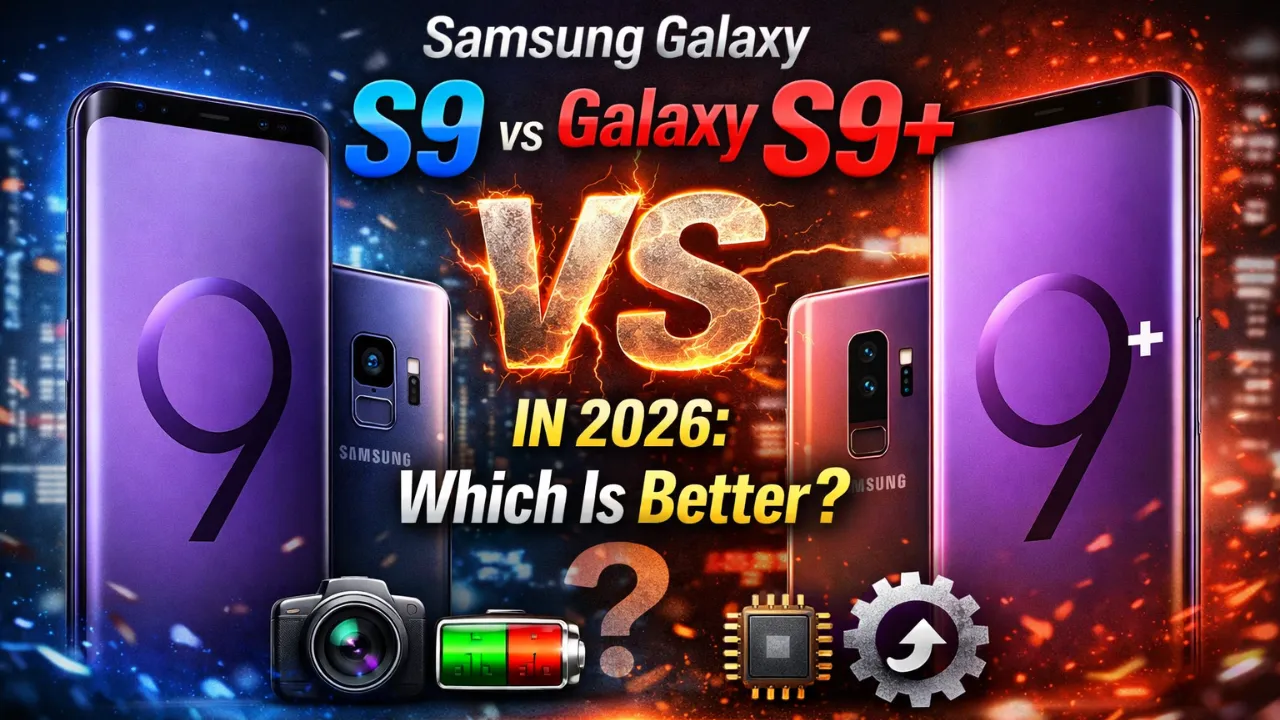
Interest in how the Samsung Galaxy S9 stacks up against the S9+ hasn’t faded by 2026, simply due to their past status as top-tier models and continued availability secondhand. Back when they launched on March 16, 2018, Samsung presented these two as sleek high-end choices – curved Super AMOLED screens setting the tone, while dust and water protection rated at IP68 added durability. Charging options? Both support wireless power delivery along with rapid cable-based refueling. Unlike some modern smartphones, they also accept microSD cards, giving users room to grow storage. Their cameras received thoughtful tweaks over prior versions, delivering sharper results under varied lighting. For that reason alone, even now, they outperform plenty of entry-level phones released years later.
Now, how old a phone is shifts everything. Come 2026, the Galaxy S9 feels smaller, easier to hold, yet the S9+ fits more needs since it packs extra memory, lasts longer on one charge, uses two rear cameras including an optical zoom lens. This difference hits harder today compared to release day, given secondhand shoppers aren’t chasing fresh looks anymore. Toughness, ease of use, cost efficiency, real-world reliability – those traits shape choices now.
That’s what keeps the S9 versus S9+ talk alive. Holding onto something compact yet high-end matters to some, whereas others look at bigger screens for extra comfort down the line. Come 2026, either model manages everyday jobs just fine – yet counting on one full time brings risks. Software updates stopped back in 2022 from Samsung, so trust fades when security gaps grow. These handsets fit better today as extras, spares, video players, or bare-bones picks instead of main companions.
So here’s what matters – not just specs on a sheet. What really counts is who you are as a person holding the phone right now. Your choice ties to how big you like your screen, how often you charge, whether snapping photos in dim light feels essential, and if running outdated programs keeps you up at night. Each factor bends the decision one way or another.
Quick Verdict
Later on, come 2026, many people will find the Samsung Galaxy S9+ fits their needs just right. With 6GB of RAM tucked inside, it handles multiple apps without slowing down. Its 3,500mAh battery keeps going strong through long days. On the back, two 12MP cameras work together – offering real 2x zoom that changes how you shoot distant scenes. Because of these features, switching between tasks feels natural, screen time stretches further, and photos adapt easier to different situations.
Compact size keeps the Samsung Galaxy S9 relevant today. Smaller than most, it fits better in your palm. Light build helps when holding it for long stretches. One-handed use works without strain. Comfort wins over screen real estate here.
By 2026, picking either as your primary device comes with clear limits. Support from Samsung stopped long back, while user forums show the S9 family has missed recent security patches. So these phones belong in the past unless priced low, assuming they’re still in top shape.
Samsung Galaxy S9 vs Samsung Galaxy S9+: Key Differences at a Glance
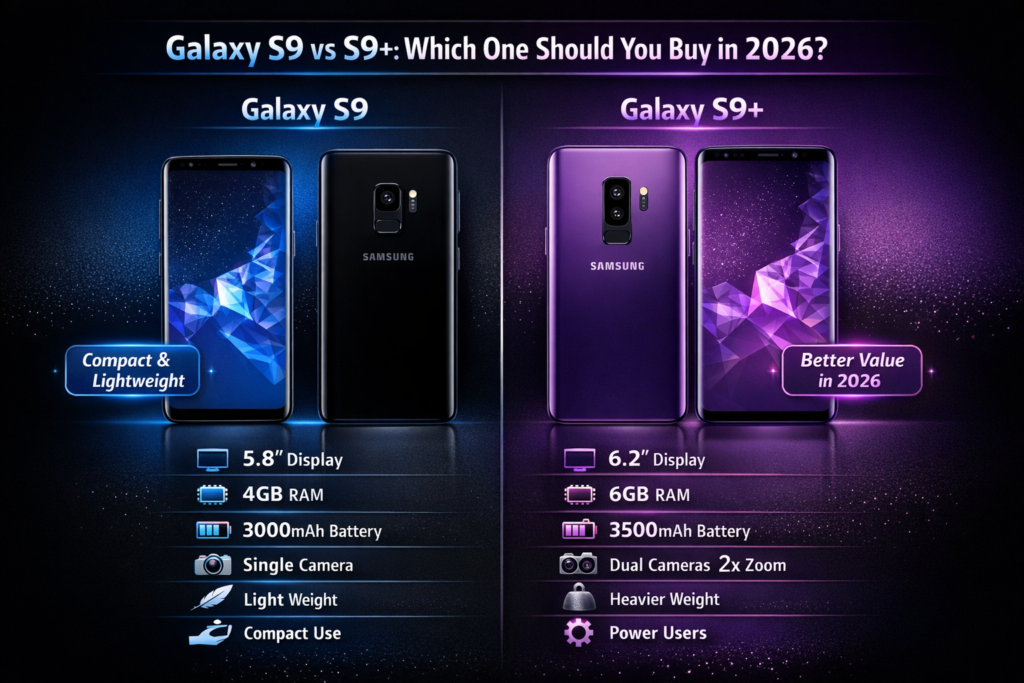
| Feature | Galaxy S9 | Galaxy S9+ | Better Choice |
| Display | 5.8-inch Quad HD+ Super AMOLED | 6.2-inch Quad HD+ Super AMOLED | S9+ for media |
| Weight | 5.75 oz | 6.67 oz | S9 for comfort |
| RAM | 4GB | 6GB | S9+ |
| Battery | 3,000mAh | 3,500mAh | S9+ |
| Rear Camera | Single 12MP with OIS and dual aperture | Dual 12MP with dual OIS and 2x optical zoom | S9+ |
| One-handed use | Easier | Harder | S9 |
| Software support in 2026 | Ended | Ended | Neither |
| Best for | Small-phone lovers | Most used-phone buyers | Depends on need |
This table shows the central trade-off very clearly. The Galaxy S9 wins on portability and hand comfort, while the Galaxy S9+ wins on the features that matter most in daily life: memory, battery, camera flexibility, and screen size.
Design and Build Quality
Even now in 2026, the Galaxy S9 holds up – its blend of glass and metal keeps it looking sharp. Curved edges flow into narrow borders, giving it a sleek profile you can actually grip without effort. Its smaller size stands out simply by being different from today’s bulky models. People fed up with huge screens tend to reach for this one without thinking twice. How it fits in your hand makes daily tasks feel less like juggling a slab. Shape matters, especially when most new phones ignore comfort altogether.
The Galaxy S9 comes in at 5.81 by 2.70 by 0.33 inches, weighing 5.75 ounces. Meanwhile, the Galaxy S9+ stretches to 6.22 by 2.91 by 0.33 inches and tips the scale at 6.67 ounces. Holding both, you feel that gap right away. Slipping the S9 into a pocket? Much smoother. It fits better in your grip too. Long stretches using just one hand leave less strain with the smaller model. Yet the larger phone feels denser, somehow more serious about videos and games. Though heavier, it asks more from how you carry and handle it daily. That size shift changes things – quietly but definitely.
One thing stands out – both gadgets came packed with high-end perks that set them apart as top-tier models back in 2018. Take Samsung’s specs: dust and water protection rated IP68 shows up right away. Then there is desktop-style multitasking through Samsung DeX, which surprises even now. Voice assistance comes via Bixby, while mobile payments work using Samsung Pay. Security gets extra layers thanks to Samsung Knox. Sound plays wide and clear from dual front-facing speakers shaped by audio experts at AKG. A USB-C port handles charging and data transfer. Contactless payments stay possible due to built-in NFC. Storage can grow too – a slot accepts microSD cards, going as high as 400GB. Even today, these traits make older units appealing since functionality stays strong despite lower secondhand costs.
A phone that’s been cared for tends to age pretty gracefully. Even now, an S9 or S9+ in good shape manages to seem refined – smooth in look and touch. What really sets it apart isn’t how it’s made. Size is the quiet game-changer here. Inside the smaller frame, the S9 packs flagship power. Bigger on size, the S9+ brings extra room to move.
Which one feels better in the hand?
Starting with how it rests in your hand, the Galaxy S9 fits more naturally during daily use. Holding on stays simpler thanks to its smaller frame when moving around. Slipping into pockets happens without effort because of its compact size. Reaching across the screen with just one thumb? That task turns noticeably smoother on the S9. Now consider the S9+ – its wider body draws favor from those eyeing extra space up front. Watching videos or reading articles lands as a calmer experience there. Bigger visuals arrive courtesy of its stretched display real estate. So here’s the core truth: physical ease lives with the S9, whereas media immersion leans toward the S9+. Enjoyment shifts depending on what matters most under your fingers.
Display Comparison
Curved Quad HD+ Super AMOLED screens appear on both Samsung devices – still a key similarity today. Not just size sets them apart: the S9 packs a 5.8-inch screen at 570 ppi, whereas its sibling, the S9+, runs slightly larger at 6.2 inches and 529 ppi. Even so, resolution stays identical – 2960 by 1440 pixels across each. Same story with shape: every model sticks to an 18.5-to-9 screen proportion.
The S9 seems crisper at first glance since it packs more pixels into a tinier display. Yet when actually using both, that edge blurs. Most people end up focusing less on clarity and more on how much bigger one feels in hand.
Watching videos feels better on the S9+ – its screen gives extra room. Long reads flow easier across the wider surface, while games take advantage of the expanded view. Splitting apps side by side works naturally thanks to the size. Yet the smaller S9 draws interest when compact design matters most. Display sharpness stays top tier even in the tighter frame. Both screens shine with vivid depth, powered by AMOLED technology. Blacks appear truly dark, colors stay punchy. Budget devices often fall short where these two keep their edge.
Simple display example
Spending hours glued to videos, matches, or endless scrolls? The S9+ stretches each view wider. Mostly swapping messages, chatting, scrolling feeds here and there – then tapping away? The S9 handles it without weighing down your pocket. By 2026, that’s what screen size boils down to: how it fits your grip, not just your gaze.
Performance and Everyday Speed
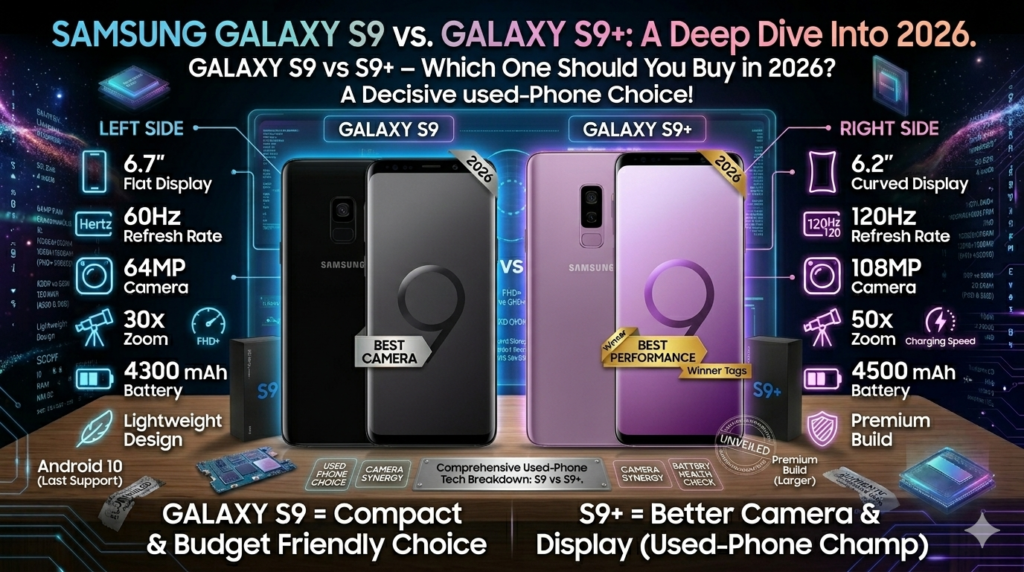
When they first came out, the two phones ran on Samsung’s top-tier 10nm eight-core chip. Described by Samsung as a 64-bit processor built on 10nm tech, it paired fast cores near 2.8GHz with slower ones at about 1.7GHz. Though it stood out back in 2018 just for raw specs, even now it holds up fine for everyday tasks.
Memory stands out as the real deciding factor. With 6GB of RAM, the Galaxy S9+ holds an edge over the Galaxy S9’s 4GB setup. Come 2026, this gap hits harder than most anticipate. Software now takes up more space. Running several things at once pushes older specs further. Background routines chew through resources faster than before. Even though a 4GB phone keeps working, juggling active apps exposes its limits quicker. Jumping between tasks feels less smooth after a while.
Headroom’s better on the S9+. Not exactly fast by today’s standards, yet it handles pressure smoother than its sibling. Extra RAM makes shifting between apps less fussy, tabs stick around longer, interface breathes easier.
Real-world performance in simple terms
Around 2026, either device should handle talking, texting, web searches, videos, social media, or similar light routines. When demands stay low, the S9 gets by just fine. If stretching further matters, picking up the S9+ brings relief. With more memory onboard, things move Easier – Slightly kinder on missteps.
Still, calling these models anything close to today’s top-tier devices would miss the point. One glance at how apps run hints at their years, plus software updates won’t last forever, while daily wear only underlines they’ve seen better days.
Camera Comparison: The Biggest Difference Between S9 and S9+
One thing stands out when looking at the Samsung Galaxy S9 versus the Samsung Galaxy S9+. A lone 12-megapixel shooter sits on the back of the Galaxy S9, backed by steady imaging tech plus an adjustable aperture. Meanwhile, its bigger sibling packs two 12MP lenses, each stabilized separately. Zooming in twice without losing quality? That comes standard. Blurred backgrounds while keeping subjects sharp – that feature shows up here too.
One thing both phones share? An 8-megapixel front camera – selfies turn out nearly identical. But when it comes to the back cameras, differences show up fast. Not just small tweaks either – the upgrade stands out clearly.
Even so, the S9 handles everyday pictures just fine. On the flip side, the S9+ opens up extra room to experiment with different styles. Zooming in closely? That second lens makes a real difference when capturing faraway things or people. Instead of stretching pixels, you get actual optical reach. Shaky hands matter less too – both lenses adjust independently to keep images steady.
Why the S9+ camera wins in 2026
Should your photos often feature loved ones, animals, meals, far-off places, city life, or people close up, the S9+ brings a sharper edge through its adaptable lens setup. Zooming optically makes a difference when preserving fine textures matters – even how subjects sit within the frame gains subtle improvement.
A different lens setup changes how you take pictures with the S9+. While the smaller version handles regular shots just fine, extra options tend to sway buyers. Used market choices hinge on these details, especially when snapping various scenes plays a big role in decision making.
Camera example
Imagine everyone together, laughing around the table. With the S9, snapping a quick photo works just fine. The S9+, though, pulls faces closer without losing detail. It separates people from messy backgrounds more cleanly. Blur effects feel sharper, more intentional. Because of these small gains, it simply does more when moments matter.
Battery Life and Charging
Besides performance, the Galaxy S9+ stands out with its long-lasting power. Samsung gave the S9 a 3,000mAh cell, while the bigger sibling packs 3,500mAh. Charging options include quick plug-in plus contactless pads – both felt high-end back when they launched. For users at the time, plugging in or setting down to charge was smooth and efficient.
Outlasting the competition isn’t guaranteed, yet the S9+ packs more juice under the hood. A mix of browsing, calls, and apps? That model handles it with room to spare by bedtime. Light on phone habits? Then the original S9 might just keep up. Less capacity inside means less staying power when tasks pile on.
Here’s where battery age plays a role. These devices have been around long enough that most secondhand models carry worn cells. So the gap in capacity might hit harder during real use. An S9+ with better cell health could mean steady power versus midday plug-ins just to keep up.
Battery in simple terms
Should you reach for your phone many times each day, go for the S9+. Only tapping now and then? The S9 might do – though its power cell trails behind. Because of that stronger energy supply, the S9+ stands firmer when traded secondhand in 2026.
Software Support in 2026
This part matters more than others if you plan to rely on one of these phones every day. Though once flagship models, the Galaxy S9 and S9+ now sit outside Samsung’s active update cycle. By 2022, official backing had ended – that’s what users in forums consistently report. Security patches stopped arriving around then. As for system upgrades, Android 10 paired with One UI 2.5 marks the final full version these devices ever got.
Now the talk around purchases shifts entirely.
Even if a phone powers on, takes a charge, opens apps, feels solid in hand – updates matter. Outdated systems carry hidden costs. Security grows thin after a while. Things start to clash, slowly at first. Trust fades when handling money talks, job messages, personal logins.
Nowhere near today’s updates, the S9 line fades further back as Samsung’s site lays out exactly when each Galaxy stops getting patches.
What this means for buyers
One reason to pick an S9 might be giving it to a kid. Or maybe keeping it around with a spare SIM card. It could work just fine for watching videos. Another option is using it when your main phone needs a break. For anyone needing solid performance every day through 2026, these phones fall short. Updates stopped coming long ago. That gap matters more than most realize.
Storage and Expandable Memory
A pair of handsets came with choices reaching 64GB, per Samsung’s official details; either one takes a microSD card – still able to stretch capacity by 400GB today. Even now, years later, extra space like that shows its worth without fanfare.
Storage you can grow stands out as a quiet strength of past Samsung flagships. Though recent smartphones often skip microSD slots, the ability to pile on extra room for pictures, clips, saved songs, or files keeps the S9 line useful compared to fresh but limited low-cost picks.
Even so, extra storage space isn’t the same as getting regular security fixes. More room helps a bit, yet it won’t fix how long the system keeps receiving support. Still, having more memory doesn’t replace timely software updates. Helpful though it may be, it leaves deeper issues untouched.
Storage example
Storing movies you download? A microSD slot helps. Music saved right on the phone sticks around easier with extra space. Photos backed up locally take less effort when storage stretches further. Yet security matters more now than ever before. By 2026, using your device safely each day outweighs how much you can add. Expansion becomes handy, sure. Not the reason to pick one gadget over another.
Feature Comparison Table for SEO Readers
| Feature Area | Galaxy S9 | Galaxy S9+ | Winner |
| Size | Smaller and lighter | Bigger and heavier | S9 |
| Display | 5.8-inch | 6.2-inch | S9+ |
| RAM | 4GB | 6GB | S9+ |
| Battery | 3,000mAh | 3,500mAh | S9+ |
| Rear Camera | Single 12MP | Dual 12MP | S9+ |
| Zoom | Digital only | 2x optical zoom | S9+ |
| One-handed use | Better | Worse | S9 |
| Media use | Good | Better | S9+ |
| Software support | Ended | Ended | Neither |
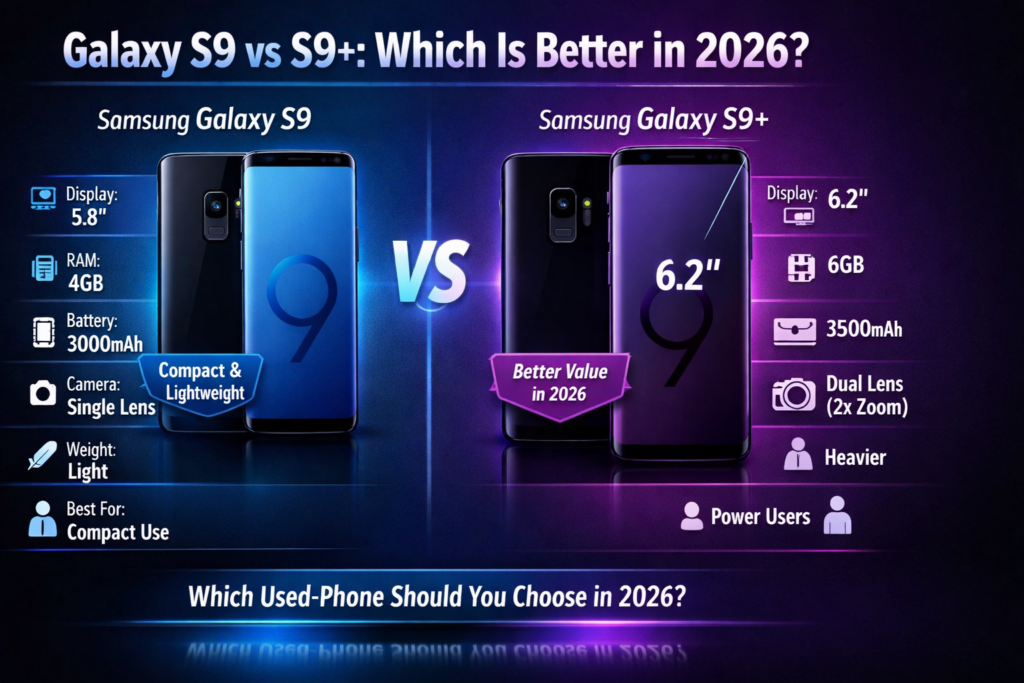
This summary table captures the heart of the comparison. The S9 is the smaller, easier, more pocket-friendly option. The S9+ is the better all-round used-phone purchase because it has the stronger combination of display size, battery endurance, RAM, and camera capability.
Which One Should You Buy in 2026?
Buy the Galaxy S9 if:
Go with the S9 when size matters less, ease of grip counts more. If handling feels off in your palm, that small shift helps. Cameras take a back seat here – fine, since you value pocket space over features. Heavy phones slow you down; this one stays light. Daily walks, commutes, long holds – it sits right without drawing attention. The bigger models shout; this one keeps quiet, fits snug.
Still, the S9 stands out as a sleeker small-scale pick. For anyone annoyed by how today’s phones stretch wide, weigh too much, or feel clumsy, it offers something rare. Even now, its charm holds up – better than many recent models manage.
Buy the Galaxy S9+ if:
Pick the S9+ when you’re after longer battery life, extra memory, improved photo quality on the back camera, yet still want solid secondhand pricing. Most people find it makes smarter sense since it lines up display width, power supply stamina, and picture sharpness better than the standard S9 ever does.
The S9+ packs a stronger mix when buying secondhand. For folks needing slightly more space but not ready to step up to pricier or newer models, it makes sense – offering balance where it counts.
Buy neither if:
Pick something else entirely when looking for a Primary Device meant to stay safe and functional through 2026. After Samsung stopped backing the line four years ago, these models aged into roles better suited for spare or low-cost options. Instead of relying on them daily, consider their place more like fallback picks now.
Truth be told, that wraps it up. While their gadgets hold a certain appeal, nostalgia hardly matches practicality when living today.
Pros and Cons
Galaxy S9 Pros
The Galaxy S9 is smaller and lighter than the S9+. It is easier to use with one hand, feels less bulky in the pocket, and still offers the same premium display quality, IP68 resistance, wireless charging, and microSD support.
Galaxy S9 Cons
Its 3,000mAh battery is smaller, it has only 4GB RAM, it uses a single rear camera, and it no longer receives active software support in 2026.
Galaxy S9+ Pros
The Galaxy S9+ has a larger 6.2-inch display, 6GB RAM, a bigger 3,500mAh battery, and a dual rear camera system with 2x optical zoom and dual OIS. These are the exact features that make it feel more useful as a used phone today.
Galaxy S9+ Cons
It is bigger and heavier, it is less comfortable for one-handed use, and it is also unsupported in 2026.
Best Use Cases in 2026
Galaxy S9 best use cases
The Galaxy S9 is best suited for users who want a compact backup phone, a simple media device, or an inexpensive secondary handset. It is also ideal for people who strongly prefer smaller phones and do not want a large display dominating the hand.
Galaxy S9+ best use cases
The Galaxy S9+ is better for users who want a larger screen, stronger battery life, and a more capable camera system. It is the better choice for photos, video watching, and multitasking.
If you are buying on a tight budget and want the most usefulness per dollar, the S9+ generally delivers more of that value.
Real-Life Buying Advice
People checking out older top-tier phones usually fixate on numbers alone. Yet those figures tell half the tale. Come 2026, it isn’t simply about who wins on paper. Comfort matters. So does safety in daily life. Value shows up when cost meets how well it fits your hand, your habits, your needs
Beyond that point, the S9+ begins to pull ahead.
Bigger tasks feel easier on the S9+. When switching between apps, extra RAM keeps things moving smoothly. Power lasts longer thanks to a beefier battery inside. Snapshots gain depth because two cameras work together behind the lens. Big screens make movies easier to enjoy. Elegance stays strong in the S9, its build still screams quality – yet the larger sibling just fits more hands better. Most will lean toward the S9+ without even trying.
Here’s something else entirely – the S9 isn’t flawed. Just different. Built for fewer people, yet hits harder for them. Where the S9+ plays it steady, covering more ground without fuss. One picks precision, the other breadth.
FAQs
Only as a very cheap secondary phone, media device, or backup device. It is not a strong main phone choice because software support ended in 2022.
Yes. For most people, the S9+ is better because it has a larger display, more RAM, a bigger battery, and a dual rear camera system with 2x optical zoom.
The Galaxy S9+ is better for photos because it has the extra telephoto lens, dual OIS, and Live Focus features.
The Galaxy S9 is better for one-handed use because it is smaller, lighter, and easier to grip.
Yes. Samsung listed microSD support up to 400GB for the S9 series.
Final Take
Picking between the Samsung Galaxy S9 and the Samsung Galaxy S9+ gets easier without emotional bias. Not big on space? Then the smaller S9 fits tighter hands better. Still, the S9+ Pulls ahead for everyday use today – especially secondhand. More memory sits inside that model, along with longer power life. Its dual-lens camera handles tougher lighting too. Only if pocket fit or fingertip reach matters most does the single-hand ease of the S9 win out.
Premium features remain on both devices, drawing interest even in used form – yet neither gets updates anymore. This fact matters most when making a decision.
