
Introduction Of Samsung Galaxy S7 vs S7 Edge
The Samsung Galaxy S7 and Samsung Galaxy S7 Edge are two classic flagship phones that still appear in the used market in 2026. Even though they launched years ago, many people still compare them when looking for a budget-friendly or backup device. Both phones share the same core hardware, camera, and performance, but differ in size, battery life, and design. This guide helps you quickly understand those differences in simple terms so you can choose the right one without confusion.
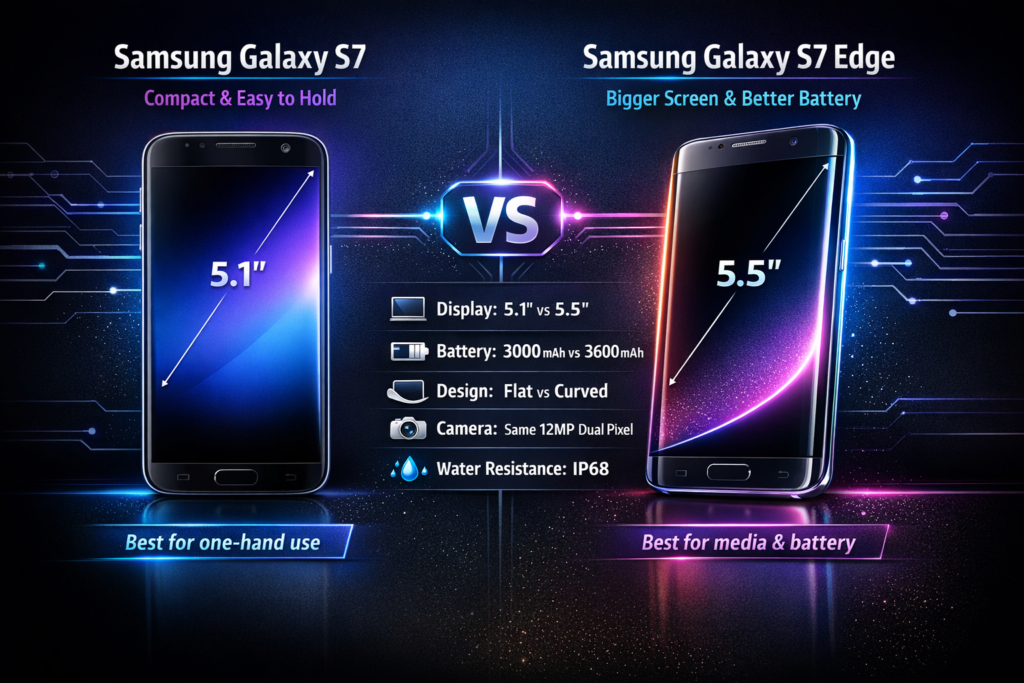
Quick Comparison
| Feature | Samsung Galaxy S7 | Samsung Galaxy S7 Edge |
| Display | 5.1″ Quad HD Super AMOLED | 5.5″ Quad HD Super AMOLED (curved) |
| Pixel density | ~577 ppi | ~534 ppi |
| Battery | 3,000 mAh | 3,600 mAh |
| Design | Flat display; compact | Curved edge display; larger |
| Weight | ~152 g | ~157 g |
| Storage | 32/64 GB + microSD | 32/64 GB + microSD |
| Water resistance | IP68 | IP68 |
| Chipset | Exynos 8890 / Snapdragon 820 | Exynos 8890 / Snapdragon 820 |
| Camera | 12MP, f/1.7, Dual Pixel | 12MP, f/1.7, Dual Pixel |
Short note: The battery and screen size are the main real-world differences. Hardware, camera, and most features are essentially the same.
Who should buy which?
- Choose the S7 if you want one-handed use, a smaller device, and a lower price.
- Choose the S7 Edge if you want longer battery life, a bigger screen for videos, and you don’t mind the curved glass.
How this guide helps you
A quick start comes first, followed by details that go much deeper. A checklist shows what matters most when buying already-owned phones. After that, the steps guide choices without slowing you down. Simple advice stays useful beyond today – testing points, swapping ideas, moments when paying more for an Edge makes sense.
Design & Build
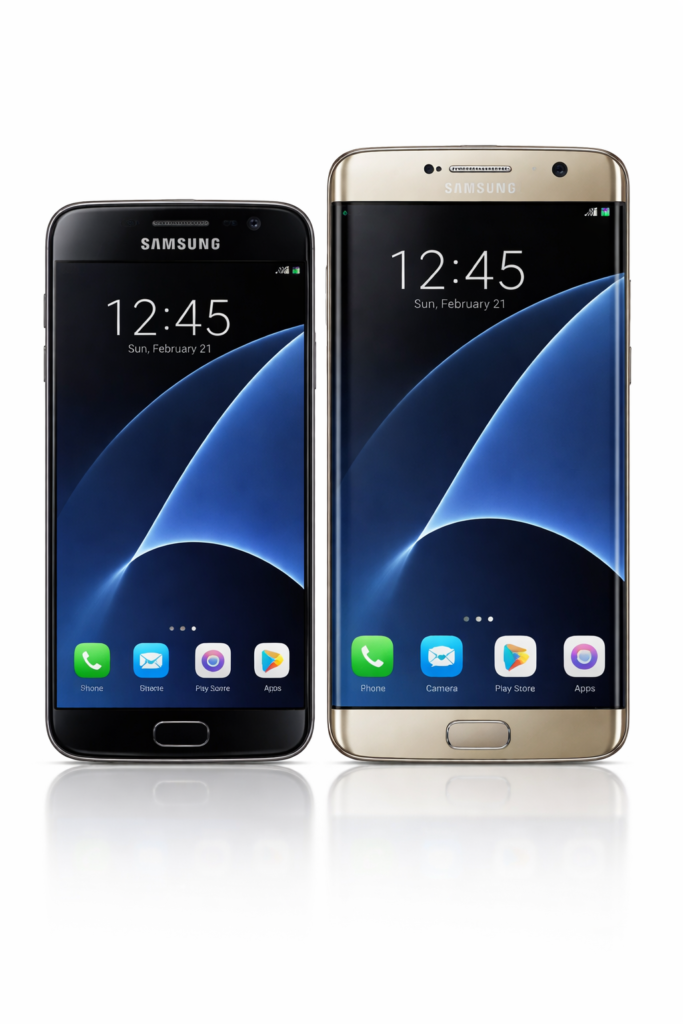
Both phones use glass on the front and back with an aluminum frame. They feel premium even in 2026, but they behave differently in daily use.
The S7
- Smaller and easier to hold in one hand.
- Less chance of accidental screen touches.
- Flat screens make screen protectors and cases cheaper and easier to fit.
- Flat-screen repairs are usually cheaper than curved-glass repairs.
The S7 Edge
- Curved glass on both edges creates the “edge” look.
- Edge panels (shortcuts) were a unique software idea when the phones were new.
- Curve makes videos feel immersive, but some people find curved phones slippery.
- Curved glass is more expensive to replace.
Verdict: If you value grip and easier repairs → S7. If you value looks and screen immersion → S7 Edge.
Display Size vs Sharpness
Both phones have Quad HD Super AMOLED screens. That means great color, deep blacks, and excellent contrast.
- S7: 5.1″ Quad HD (~577 ppi). Very sharp for its size.
- S7 Edge: 5.5″ Quad HD (~534 ppi). Slightly lower pixel density but a larger viewing area.
Real use:
- Reading text and looking at photos: both excellent.
- Watching videos and gaming: you’ll prefer the S7 Edge for its larger screen.
- Pocketability and one-handed use: S7 wins.
Battery Life & Charging
This is the clearest real-world difference.
- S7 battery: 3,000 mAh.
- S7 Edge battery: 3,600 mAh.
Real-world expectations (typical for used phones in 2026)
| Usage type | S7 (screen-on hrs) | S7 Edge (screen-on hrs) |
| Light use (calls, messages) | 4–6 hrs | 6–8 hrs |
| Moderate (social, browsing) | 3.5–5 hrs | 5–7 hrs |
| Video playback | Good | Excellent |
Early trials found the Edge runs about a half again as long under similar conditions. By 2026, how well the battery holds up becomes far more relevant: older devices still on their first cell deliver less juice. A fresh power pack can significantly boost performance, far beyond what changing handsets can achieve. That kind of upgrade sometimes outdoes getting a new model.
Charging
- Both support their era’s fast charging and wireless charging.
- Charging speeds are slower than modern flagships (2024–2026), but still fine for daily top-ups.
Tips to extend battery life in 2026
- Replace the battery if it’s more than 2–3 years old.
- Use dark mode. AMOLED screens use less power for black pixels.
- Disable unused background apps.
- Use Power-Saving modes while traveling.
Verdict: For battery, the S7 Edge wins a clear practical advantage.
Camera
The two devices share a 12MP f/1.7 Dual Pixel primary sensor. Since their camera components match, the image output stays almost indistinguishable.
- Fairly strong in dim settings back when they came out.
- Crisp focusing happens fast, powered by Dual Pixel design.
- Even now, plenty of people enjoy the way colors look natural. A lot stick with it just because it feels right to them.
When fancy camera tricks like night vision or AI tweaks matter to you, trying another app might yield some gains, yet the phone’s physical parts stay unchanged. Though extra software can shift how photos turn out, what the device itself can do doesn’t suddenly improve.
Performance & Software
One phone ran on the Exynos 8890, found in global models. The other used the Snapdragon 820, common in US and Chinese versions. These were top-tier chips when released in 2016.
What to expect in 2026
- Even simple jobs like calling or sending texts keep working okay. Light apps run without much trouble either. Just doing the usual stuff tends to go smoothly now.
- Frequent hiccups can hit demanding software these days. Some newer titles run unevenly when pushed hard.
- Back then, 4 GB of memory kept multitasking in check – just how things were built at the time.
- Years have passed since official support stopped. Staying on an outdated Android means skipping custom ROMs.
Tinkering not your thing? Stick to slimmed-down apps, live with their rules.
Should tinkering appeal to you, community-made custom ROMs might offer extra features alongside security updates, though they require know-how and carry a degree of uncertainty. Skill matters here, risks exist, too.
Storage & Expandability
By 2026, plenty of new phones will skip microSD slots entirely—this one still includes it—a useful edge when few others do.
- Storage inside often comes in 32GB or 64GB, though availability varies by region. While some places favor one size, others might only offer the alternative.
- A tiny microSD card slips into your device, adding space without spending much. Cards starting at 256GB fit right in, quietly boosting capacity. Storage grows, yet the price stays low.
- Saving room inside your device? Slide photos and clips onto a microSD card or upload them to the cloud. Storage tight? Toss those files off to extra memory spots instead. Need breathing space? Shift visuals over to external storage. Files piling up? Bounce them into online spaces or nearby tiny cards. Running low? Move snapshots and recordings out – clouds hold plenty, so do little SD chips.
Durability, Repairability & Common Issues
Durability
- Both phones are IP68 rated, resistant to dust and water splashes.
- The S7 Edge is more vulnerable to edge damage because of curved glass.
Repairability
- Both scored low in teardowns for repairability (hard to fix: glued glass, tricky battery removal).
- Removing the back or screen needs heat and special tools. Edge screen replacements cost more.
Common issues in 2026
- Battery degradation is common; replace if needed.
- AMOLED burn-in may appear on older displays with long static UI usage.
- Overheating shows up during heavy use or with poor battery health.
- Water damage: Check the moisture indicator if possible.
Verdict: S7 is slightly easier and cheaper to repair than S7 Edge because flat displays are cheaper to replace.
Used Market Value (2026 Buying Guide)
Fresh off the secondhand market in 2026, each of these phones carried a price shaped by wear, location, or past repairs – especially if the screen or power cell had seen changes. What you paid depended less on brand and more on how hard the device had worked before reaching your hands.
- S7: typically lower price, budget-friendly.
- A curved display often means a slightly higher cost, yet the payoff comes in sharper visuals. Power lasts longer, which matters when you are away from outlets. This model trades extra dollars for stronger performance where it counts.
Worth the added price? Screen size plus battery performance say yes. Same cost? Go for the S7 Edge. Price gap narrows value fast. Edge.
Accessories & Parts Still Available
Even in 2026, parts are available from many sellers:
- Cases and screen protectors remain common.
- Replacement batteries and chargers, original and high-quality third-party options.
- Genuine screens can be found, but Edge screens cost more.
Tip: When replacing parts, prefer original or well-reviewed third-party parts.
Repair & Battery Replacement
- Battery replacement is often the cheapest and most useful upgrade.
- Edge display replacements are a pricier factor to factor into the purchase price.
- Use trusted repair shops, or follow community guides if you have the skills.
Longevity
True, they handle routine things – making calls, using WhatsApp, scrolling lightly through social feeds, playing tunes, checking websites. Yet performance dips when running cutting-edge games, intensive applications, or when accessing up-to-date system tools. Need 5G speed, generous memory, or software support that lasts years? Newer models fit better.
Decision Flow
- Need a compact phone → pick S7.
- Need better battery and media experience → pick S7 Edge.
- Need modern features and long software support → buy a newer phone.
- Buying used → follow the checklist above and prefer Edge if prices match.
Appendix
Samsung Galaxy S7 (summary)
- Display: 5.1″ Quad HD Super AMOLED (~577 ppi)
- Battery: 3,000 mAh
- Camera: 12MP f/1.7 Dual Pixel
- Chipset: Exynos 8890 / Snapdragon 820
- Weight: ~152
Samsung Galaxy S7 Edge (summary)
- Display: 5.5″ Quad HD Super AMOLED (~534 ppi)
- Battery: 3,600 mAh
- Camera: 12MP f/1.7 Dual Pixel
- Chipset: Exynos 8890 / Snapdragon 820
- Weight: ~157 g
FAQs
The S7 Edge has a larger 3,600 mAh battery and usually lasts significantly longer than the S7’s 3,000 mAh cell.
Yes, for most people, mainly for the bigger screen and better battery life. Choose S7 for compact size and lower price.
Yes for calls, messaging, and light apps. But performance is limited, and official software updates ended years ago; you might need to install custom ROMs to get the latest Android features.
Yes, both use the 12MP f/1.7 Dual Pixel camera and take very similar photos.
It looks premium and offers shortcuts, but many users have accidental touches, and curved glass is costlier to repair.
Conclusion
When it comes to picking between the Samsung Galaxy S7 and the Galaxy S7 Edge, what matters most is how you plan to use it—holding comfort and lower fixed costs? The S7 fits that need well. Need more screen space and stronger Power Endurance throughout the day? That’s where the S7 Edge pulls ahead. Still, considering their age by 2026 standards, neither handles heavy work smoothly. They can manage simple jobs just fine – think messaging or web browsing – or serve as backups when your main device rests. A modern model tends to deliver smoother speed, updated tools, plus support that lasts beyond a year or two. Time makes older tech feel slow; these models show every bit of it now.
